The Forge — Armory Forge Systems — Signet Article #030
Your phone rings. You're on a job, you're in a meeting, you're doing the books — you're anywhere but at the desk. The caller gets voicemail. Or worse, they get nothing.
That call was a customer. That call was a job. That call just went to the competitor who picked up.
Every business owner knows this feeling. You've felt it the day a big job slips away and you find out later the customer tried you twice first. You don't need a statistic to know what a missed call costs — you've already paid it.
The fix isn't "answer the phone more." You can't. You're one person doing the work of five. The fix is a worker whose entire job is the phone — and this is the second in our series about enterprise workers: AI employees built to do one job at an enterprise level, without the enterprise headcount.
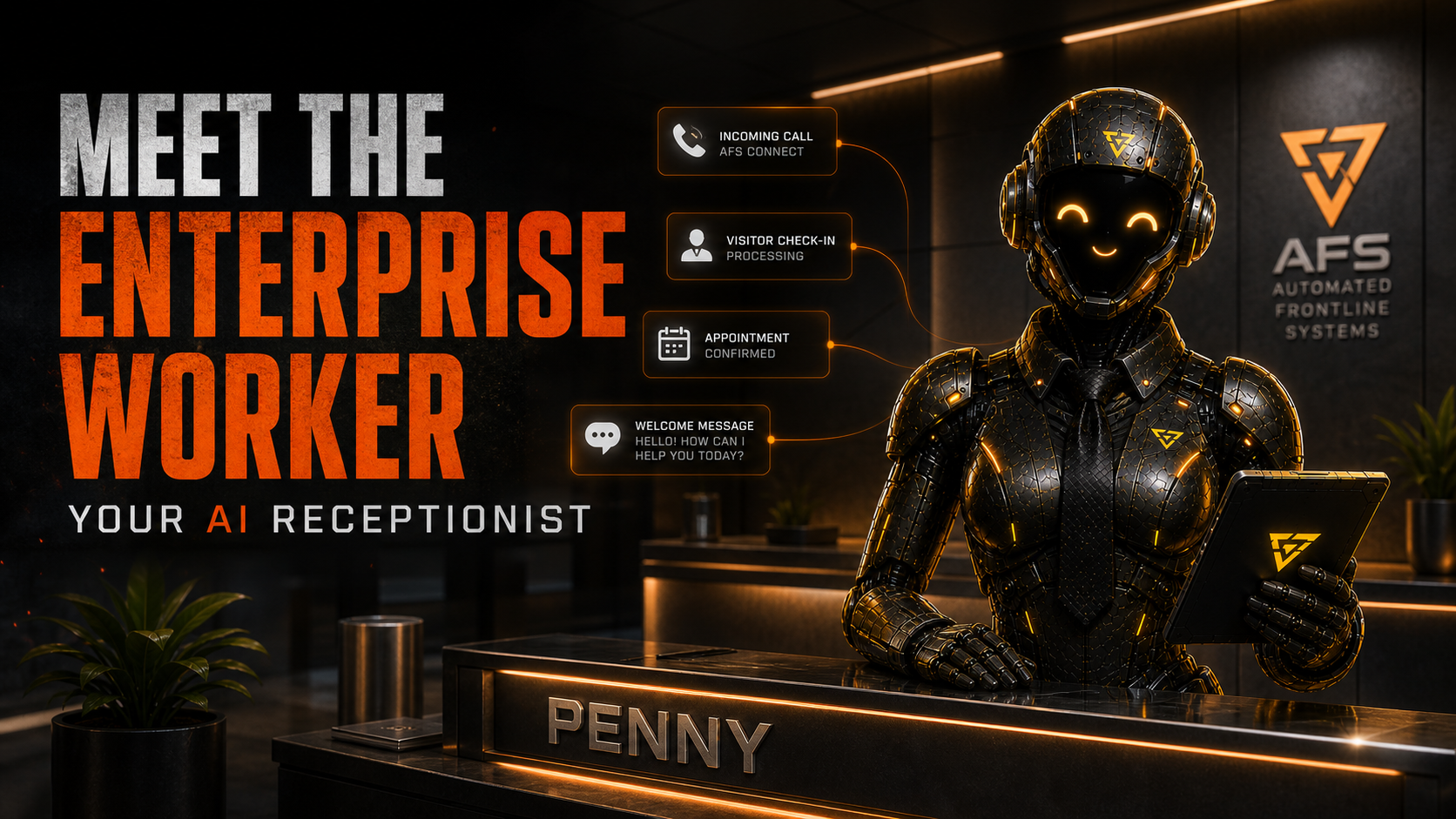
Meet the AI receptionist.
One job, done better than any generalist
An enterprise worker isn't a chatbot that answers anything. It's a specialist. The receptionist at a big company doesn't do payroll or fix the network — they run the front door, and they run it well.
The AI receptionist is the same idea: one worker, one job. Answer every call. Every time. In your voice, on your schedule, with your rules. Not a god agent trying to do everything — a specialist doing its one job at a level a small business could never afford before.
What it actually does
Every call, every minute of the day:
- Answers — always. No voicemail, no hold music, no "we'll call you back" from an inbox that's already full.
- Listens — the caller says what they need, in plain language, and the receptionist understands it.
- Books — appointments scheduled in real time, added straight to your calendar, conflicts caught before they happen.
- Routes — the right call goes to the right person, the right way. Emergencies get through. Tire-kickers get handled politely.
- Follows up — missed you? It schedules a callback and makes sure it happens. Nobody falls through the cracks.
The result is the same front door an enterprise runs — without the front desk, the payroll, and the office.
What it doesn't do
Here's the part that surprises people, just like with the executive assistant: the receptionist is deliberately limited.
It can take a message, but it can't read your customer files. It can book an appointment, but it can't move money or change a price. It can hand a call to a human, but it can't impersonate you. Every capability is a specific, limited, revocable permission — not a "do whatever seems helpful" backdoor.
That's what makes an enterprise worker safe to hand to a small business. The worker that talks to your customers all day is the one with the narrowest access to your business. It represents you without ever becoming you.
The front door of a bigger workforce
Here's the pattern: the phone is where customers meet you. That's why the receptionist is the first worker most businesses hire — it's the tip of the iceberg.
Behind it, the same workforce can grow: someone to follow up with customers, someone to keep the books, someone to watch the security, someone to know the answers your team forgets. Each one a specialist, each one doing one job at an enterprise level. But it all starts with the call that gets answered.
What Monday morning looks like
You're on a job site at 9:15. The phone rang three times while you were up a ladder. When you check at lunch, it's all there: two appointments booked, one callback scheduled for the estimator, one message from a repeat customer — handled before you ever touched the phone.
No missed calls. No "I thought someone was covering the phone." No customer who tried you twice and went somewhere else.
You didn't start your business to babysit a phone. You started it to do the work — and the work that stands between you and your customers' calls is exactly the work an enterprise worker is for.
Hire your own AI enterprise worker. Start with the one that answers the phone.
Steel is forged in the fire, then measured on the scale. The enterprise worker is how you forge a business that answers when opportunity calls.
Want to hire your own AI enterprise worker? The Armorer can help you pick the right one — no pressure, just answers.