The Forge — Armory Forge Systems — Signet Article #029
Every business owner is really five people. You're the receptionist in the morning, the accountant at noon, the sales team all afternoon, and the executive after hours — with none of the help an executive actually gets.
The owner of a small company doesn't have a chief of staff. They don't have someone whose whole job is to protect their attention: to know what matters today, what can wait, what decision is waiting on them, who's waiting for an answer, and what they promised someone three weeks ago.
That's about to change. This is the first in a series about enterprise workers — AI employees built to do one job at an enterprise level, without the enterprise headcount. And we're starting with the one that runs the executive's world: the AI executive assistant.
What an enterprise worker is — and isn't
An enterprise worker isn't a chatbot that answers anything. It's a specialist. In a big company, the CEO doesn't do their own research, run their own numbers, or answer their own front door — they have people for that. Specialists. Each one trained on one job, each one excellent at it.
An AI enterprise worker is the same idea: one worker, one domain, built to do that job at a level a small business could never afford before. Not a god agent that tries to do everything. A specialist that does its one job better than any generalist could.
The executive assistant worker
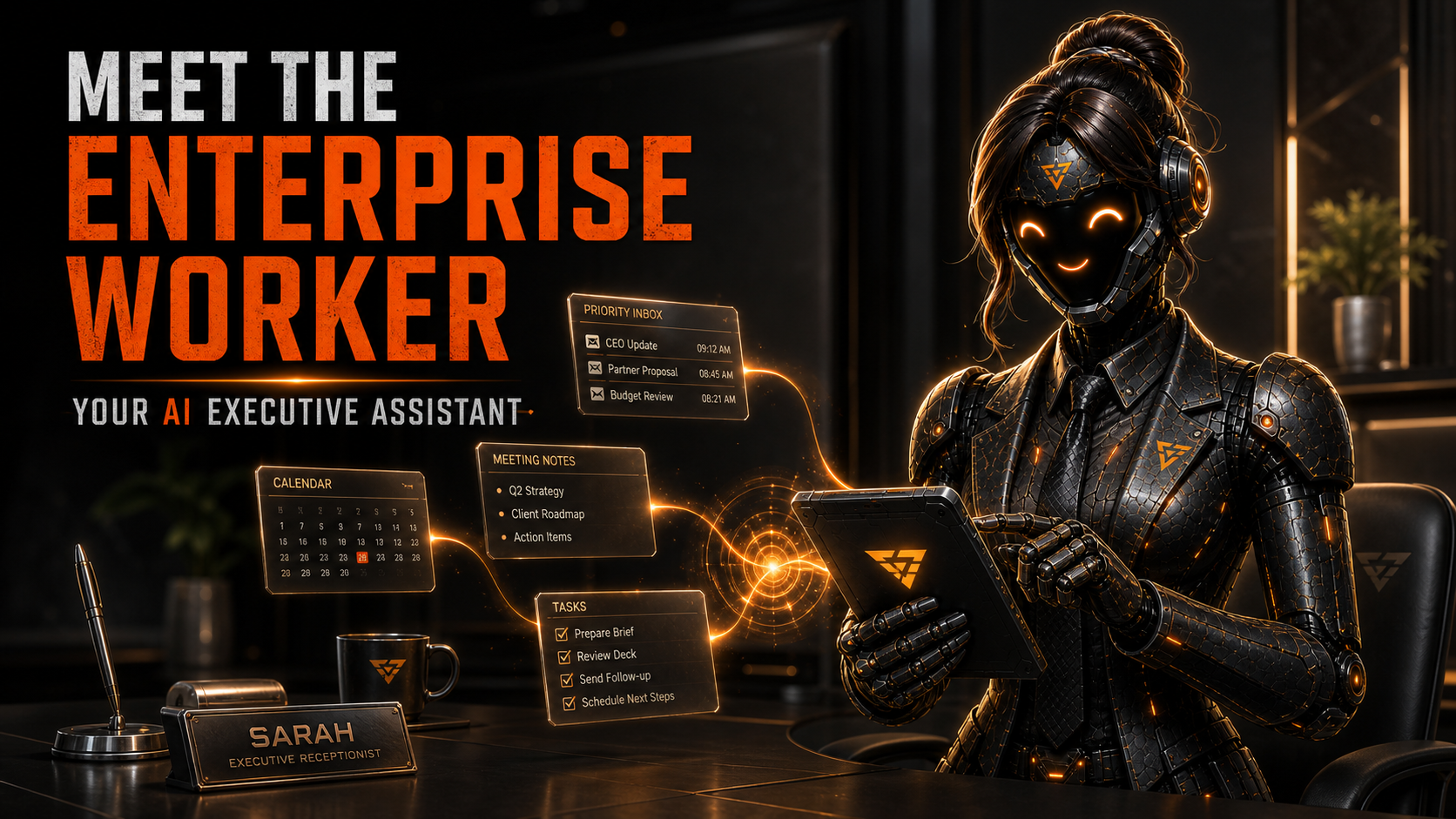
The AI executive assistant has one question at the center of everything it does: what does the executive need to know, decide, remember, communicate, or follow through on?
That's the whole job. And it shows up in every hour of the day:
- Your calendar — scheduled, protected, and prepped. Meetings have agendas, conflicts get caught early, and focus time stays blocked.
- Your inbox — triaged before you look at it. Urgent messages surfaced, threads summarized, replies drafted, deadlines flagged.
- Your meetings — briefed in advance and followed up after. Who's attending, why it matters, what was decided, and what was promised.
- Your decisions — tracked so nothing slips. Options considered, owners assigned, deadlines set, follow-ups checked off.
- Your day — briefed every morning. What needs you today, what can wait, what changed since yesterday.
Nothing gets lost. Not because the assistant is magical, but because follow-through is its entire job description.
It coordinates the rest of the workforce
Here's where the executive assistant earns its name. In an AFS deployment, the specialist workers are: Scout finds it, Ledger measures it, Wrench remembers it, CASE diagnoses it, Atlas builds it, Bastion protects it. The executive assistant doesn't duplicate any of them — it turns their work into something you can actually use.
Say a competitor launches a new service. Scout brings back the pricing and positioning. Ledger runs the economics. Wrench checks what your team can actually deliver. And the executive assistant hands you one page: here's the threat, here's what it means, here's the 30-day response plan, and here's the decision you need to make.
That's the enterprise pattern: specialists gather, the assistant synthesizes, you decide. You get the output of a whole staff — without the staff.
The rule that makes it safe
Here's the part that surprises people: even the most trusted assistant doesn't get the keys to everything. It can schedule meetings, but it can't move money. It can draft messages, but sending them follows strict rules. It can ask for research, but it can't override the security worker. Every capability is a specific, limited, revocable permission — not a "do whatever the boss would want" backdoor.
That's what makes an enterprise worker safe to hand to a small business. The assistant that knows the most is deliberately the one that can directly change the least. It coordinates the work instead of absorbing it.
What Monday morning looks like
You walk in at 8:00. Instead of a pile, you get a brief: the meeting that matters today and what you need to decide in it, the one email that actually needed a reply, the follow-up that would have slipped, and the competitor move the workforce found — with a plan already drafted. The day is organized before you've had coffee.
No missed commitments. No "I thought someone was handling that." No decisions lost in a thread from three weeks ago. Just the executive's job — deciding — left to the person who should be doing it: you.
From assistant to chief of staff
The worker starts by organizing, preparing, reminding, and drafting. Over time — with your explicit say-so — it grows: synthesizing, coordinating, tracking, and eventually executing narrowly delegated actions inside a fenced boundary.
Assistant first. Chief of staff later. Same worker, growing authority, always auditable, always revocable.
The owner of a small business doesn't need a whole executive floor. They need one worker who acts like it.
The closing thought
You didn't start your business to answer emails at 11 PM or to remember every promise you've made. You started it to build something — and the executive work that stands between you and that is exactly the work an enterprise worker is for.
Hire your own AI enterprise worker. Start with the one that gives you your day back.
Steel is forged in the fire, then measured on the scale. The enterprise worker is how you forge a business that runs without you holding every thread.
Want to hire your own AI enterprise worker? The Armorer can help you pick the right one — no pressure, just answers.