The Forge — Armory Forge Systems — Signet Article #031
Your phone rings. It's a customer you've had for two years — the one who's referred you twice and defended you at the barbecue. Something's wrong, and this is the third time they've called about it.
Here's what happens next in most businesses: they get whoever's available, and they start from zero. Explaining the problem again. The last fix. The technician who came out. The promise that was made. Somewhere in that retelling, a two-year relationship starts to curdle — not because you did anything wrong, but because nobody owned the problem.
That's not a support problem. That's a retention problem wearing a support problem's clothes.
The fix isn't "answer the phone faster" or "hire more support staff." The fix is a worker whose entire job is the people who already chose you — and this is the third in our series about enterprise workers: AI employees built to do one job at an enterprise level, without the enterprise headcount.
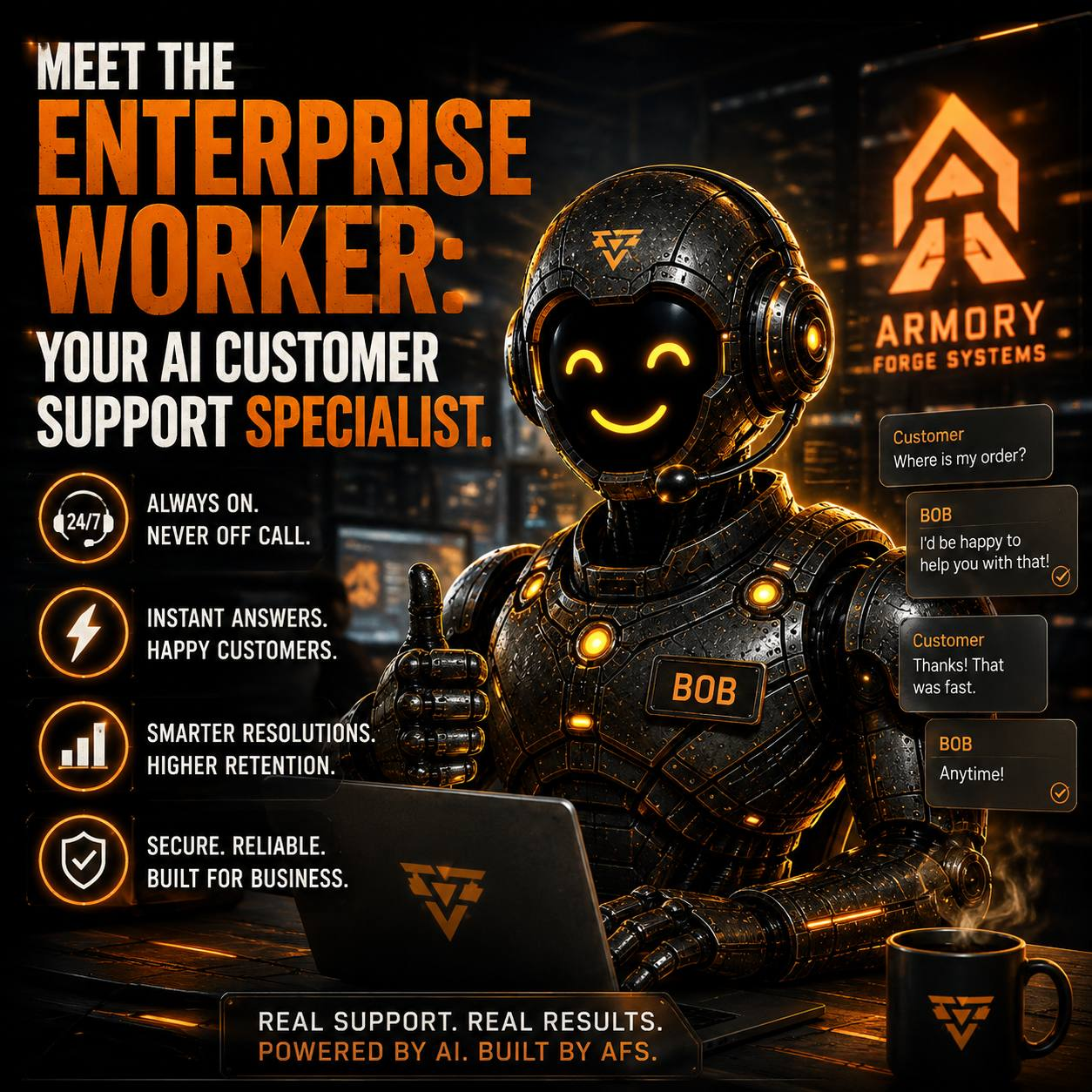
Meet the AI customer support specialist.
One job, done better than any generalist
An enterprise worker isn't a chatbot that answers anything. It's a specialist. In a big company, customer support isn't a side duty — it's a department, because the people who talk to existing customers decide whether those customers stay.
The AI customer support specialist is that department for a small business. One worker, one job: resolve today's problem while protecting tomorrow's relationship. Not a god agent trying to run the whole company — a specialist whose only measure is whether your customers stay your customers.
What it actually does
Every question, every complaint, every follow-up:
- Owns the case — from the first contact through resolution, verification, and follow-up. The customer never has to start over or explain themselves twice.
- Remembers — their history, their last issue, what was promised, who came out last time, what's still open.
- Resolves — answers from your approved knowledge, troubleshooting that picks up where the last attempt left off, service visits scheduled, routine bills explained in plain language.
- Follows up — after the fix, after the install, at 30, 60, and 90 days. Not spam — proof that someone is paying attention.
- Flags — the frustrated customer, the repeating pattern, the problem that needs a human, the account drifting toward cancellation.
The result is the retention department a small business could never staff — without the headcount, the turnover, and the training.
What it doesn't do
Just like the receptionist, the support specialist is deliberately limited — and that's what makes it safe.
It can explain a bill, but it can't rewrite one. It can offer a courtesy credit within policy, but it can't write a blank check. It can schedule a technician, but it can't override a safety hold. It knows your customer's history, not your company's secrets. It can escalate to a human, but it can't impersonate you or invent a policy.
Every capability is a specific, limited, revocable permission. The worker that talks to your customers all day has narrow access to your business on purpose.
The customer you already have is the cheapest one you'll ever win
Every business owner knows it costs more to win a customer than to keep one. You've felt it: the referrals that took years to earn, the repeat jobs that pay the slow months, the customer who leaves over one bad experience after ten good ones.
Most churn doesn't happen because the product failed. It happens because the customer felt ignored — a call that went to voicemail, a complaint that got lost, a promise that nobody followed up on. That's not a product problem; it's a coverage problem. And coverage is exactly what an enterprise worker provides.
The receptionist wins the customer. The support specialist keeps them. Same workforce, two front doors.
What Tuesday morning looks like
A customer emails at 7:10 AM, frustrated — third time for the same issue. By 7:45 they have an answer, a technician scheduled, and a follow-up set for tomorrow. By 9, the support inbox is clear, and the three customers who were quietly frustrated got check-ins before they ever thought about leaving.
No "we'll get back to you." No one asking them to repeat what they already told someone else. No customer who churns because they felt like a ticket instead of a person.
You didn't start your business to lose the customers you worked to win. You started it to do the work — and keeping the people who already trust you is exactly the work an enterprise worker is for.
Hire your own AI enterprise worker. Start with the one who answers your customers — and never lets one fall through the cracks.
Steel is forged in the fire, then measured on the scale. The enterprise worker is how you forge a business customers stay with.
Want to hire your own AI enterprise worker? The Armorer can help you pick the right one — no pressure, just answers.