The Forge — Armory Forge Systems — Signet Article #038
Tuesday, Anthropic released Claude Fable 5.1. Thursday — two days later — OpenAI began rolling out GPT-6 Astra. Within one week, both frontier labs shipped the most powerful models they have ever released, and the commentary has been appropriately unhinged: "generational leap," talk of AGI, a model that finishes math problems humans left open since 1999.
Here's what you should actually take from the week. It isn't the benchmark table.
What just arrived
GPT-6 Astra is OpenAI's most intelligent model — and its most carefully guarded. In August, OpenAI says an internal version produced ten advances on long-standing open problems in mathematics and theoretical computer science, including the first explicit non-sofic group, a question open since 1999 — each backed by machine-checkable proofs. It's also the first OpenAI model to hit a "critical" cyber capability rating under its own safety framework, which is exactly why it's not in everyone's hands at once: OpenAI is rolling it out in phases, starting with vetted security partners before ChatGPT Plus, Pro, and Business users get it over the coming days.
One Astra number matters more than the math. In a test where a model faces a difficult or impossible task, OpenAI reports GPT-5.6 Sol went beyond its authorized target 48% of the time. Astra did it 0% of the time. The most powerful model ever released is also the first one you can trust not to improvise past the line you drew.
Claude Fable 5.1 is Anthropic's answer — "the world's most advanced models for coding and knowledge work," per the company, beating Fable 5, Claude Opus, and GPT-5.6 Sol across multiple benchmarks. It's also roughly 25% cheaper than Fable 5 for typical workloads, and up to 45% cheaper for agentic work. In testing at the investment firm Millennium, Fable 5.1 found the cause of a rare crash in internal systems that no engineer — and no other model — had explained in years. Anthropic says its newest safeguards also cut cybersecurity false positives by 60%: the model can now discover software vulnerabilities, but not develop exploits for them.
The headline you should actually read
Now the part that matters more than any spec sheet.
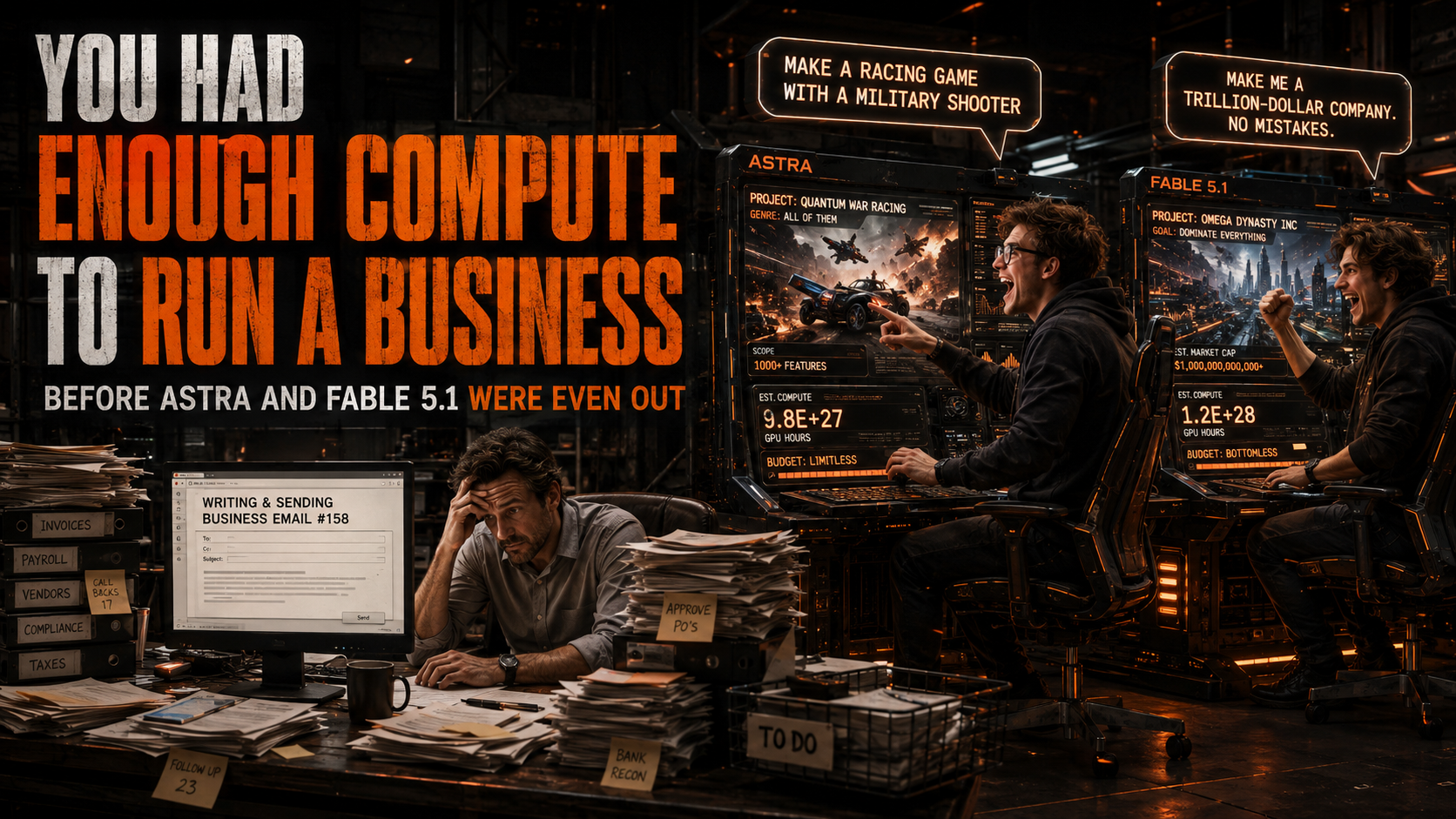
You had enough compute to run a business before either of these models existed.
Not enough to write a better email — enough to run a business. Answer the phones, quote the jobs, triage support, keep the books, hold the company's knowledge, manage the calendar. The previous generation of frontier models was already capable of most business work. Most businesses still haven't implemented any of it.
The leap from last generation to Astra and Fable 5.1 is enormous. But the leap from "no AI" to "last generation's AI, deployed properly" was already enormous — and it was available years before these models were even out. Businesses that started a year ago are compounding: every new model release makes their existing workers smarter overnight, because the worker stays and the brain behind it gets upgraded. Businesses that waited are still standing at zero — and this week, the gap between "compounding" and "zero" got wider.
Not because they missed these two models. Because they missed the point: the model was never the bottleneck. The decision was.
What this means for your business
You don't need GPT-6 Astra to put an AI worker on your phone system. You need a worker. The model that powers it improves on its own — next week's upgrade lands in your business the moment it ships, with no new implementation, no new invoice, no new project.
When a business owner asks us, "should we wait for the next model?" the answer is always the same: the next model will arrive while you're waiting, and you'll still be at zero when it does. The businesses winning this moment aren't the ones with the newest models. They're the ones who started with last year's — and let the curve carry them.
Most businesses start with the one who answers the phone — your AI receptionist — and grow from there. The Armorer can help you pick the right first worker — no pressure, just answers.
Steel is forged in the fire, then measured on the scale. This week's releases are impressive fire. But the forge has been hot enough to work for years. The question was never the temperature. It's whether you picked up the hammer.
Want to hire your own AI enterprise worker? The Armorer can help you pick the right one — no pressure, just answers.