The Forge — Armory Forge Systems — Signet Article #033
Your auditor wants evidence. Your insurer wants answers. Your vendor wants your security questionnaire filled out — again. And in the back of your mind is the question you don't want to ask: if someone got in tonight, would you even know by morning?
Here's what security looks like for most small businesses: a firewall they bought once, a password policy they meant to enforce, and a folder of screenshots they scramble to assemble the week before an audit. Not because they don't care — because they can't afford a security department.
That's not a technology problem. That's a coverage problem wearing a technology problem's clothes.
The fix isn't "buy more tools" or "hire a company to watch a dashboard." The fix is a worker whose entire job is keeping you safe — and this is the fourth in our series about enterprise workers: AI employees built to do one job at an enterprise level, without the enterprise headcount.
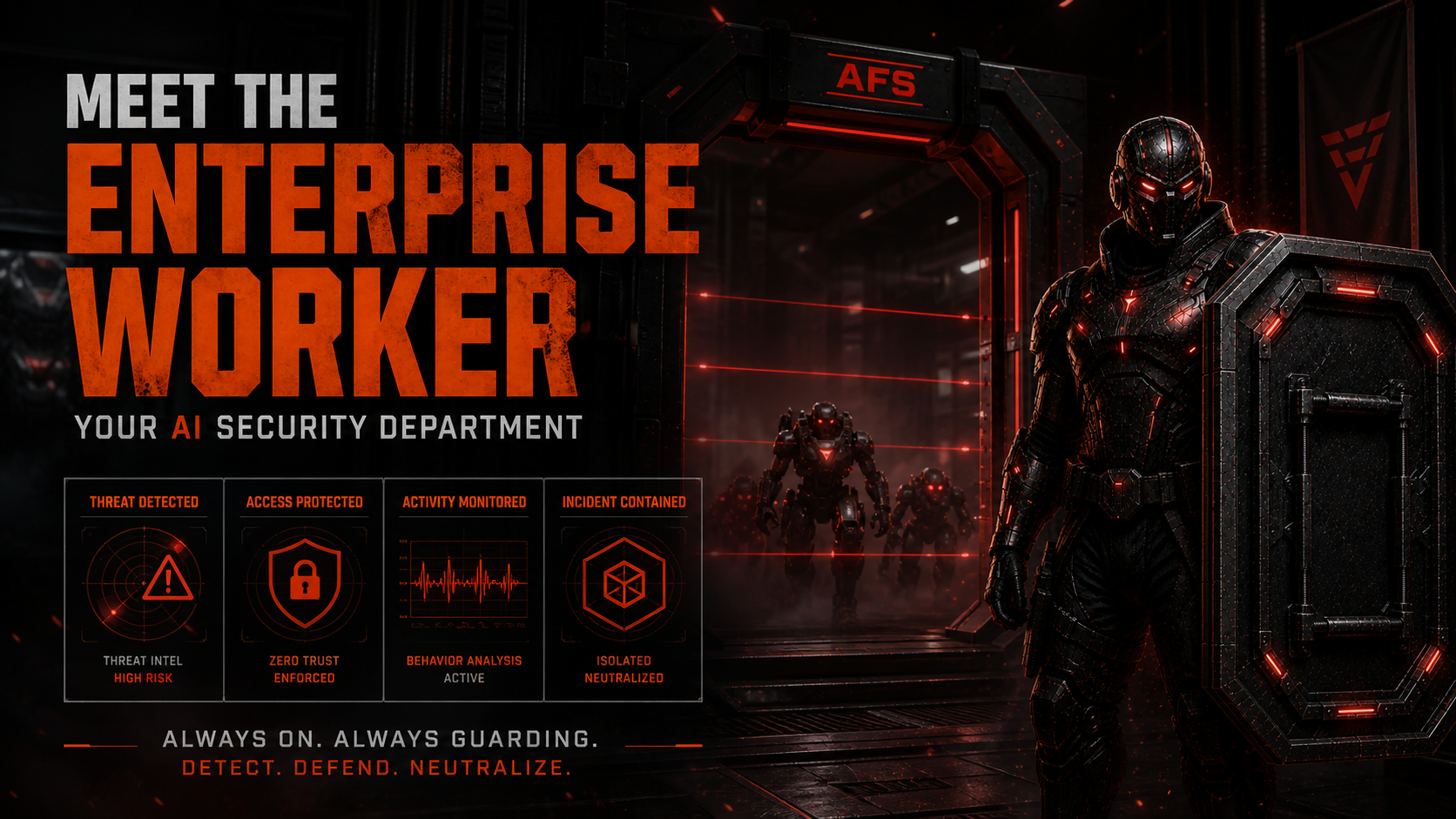
Meet the AI security department.
One job, done better than any generalist
An enterprise worker isn't a chatbot that answers anything. It's a specialist. In a big company, security isn't a side duty — it's a department, because one breach can undo years of work in a single night.
The AI security department is that department for a small business. One worker, one job: is this safe, authorized, expected, and within policy? Not a god agent with keys to everything — a specialist whose only measure is whether your business is still standing at the end of the day. We call ours Bastion — every department has a name.
The Bastion Vision: think like an adversary
Most security tools play whack-a-mole. They wait for a known signature, then fire an alert — usually after the damage is done. The Bastion vision is the opposite: a frontier-model mind applied to defense. It doesn't match patterns; it reasons. It connects the login from a foreign IP with the new admin account and the unusual export — and understands what the combination means.
When something is wrong, it doesn't dump a list of CVEs on your desk. It investigates, contains, and explains in plain language: what happened, why it matters, what to do. It anticipates attack paths before they're used and adapts to new tactics the moment they appear — no signature update required.
It's a blue-team defender: monitoring, detection, containment, and proof. Always on, always watching, human in the loop for anything that matters.
What it actually does
Every login, every change, every API call, every night:
- Detects — watches users, systems, and agents for anything that doesn't belong: compromised credentials, privilege abuse, suspicious access, data moving where it shouldn't.
- Triages — separates what's real from what's noise, with a risk score and a recommended action. You get signal, not spam.
- Remediates — fixes what it's safely allowed to fix on its own, and drafts the fix for your approval when it isn't. It can lock down a misconfigured database, but it can't delete one.
- Proves — captures evidence of every finding and every fix: what was wrong, what was done, when, and by whom. Audit-ready and exportable, on demand.
The result is the security department a small business could never staff — without the headcount, the turnover, and the training.
Compliance becomes a byproduct, not a project
Here's the part that changes your year: most compliance tools collect evidence of security and hand it to an auditor — whether or not you were actually secure. Bastion flips it. It fixes the finding first, then collects the evidence of the fix. The audit package is a byproduct of actually being secure, not a screenshot of being exposed.
SOC 2, HIPAA, GDPR, ISO 27001 — risk registers, control testing, and evidence pipelines run continuously, mapped to the controls your auditor actually asks about. The security questionnaire your vendor sends? It answers itself. The evidence your auditor wants? Already assembled — because it's gathered every day, not the week before.
Compliance metrics stop being a quarterly scramble and become a live number: findings detected, findings fixed, time-to-fix, residual risk — updated constantly instead of reconstructed under deadline.
What it doesn't do
Just like every enterprise worker, the security department is deliberately limited — and that's what makes it safe.
It can quarantine a compromised account, but it can't fire a person. It can draft a fix, but it can't destroy infrastructure or touch customer data without approval. It can't be switched off by the agent it's watching — no one can tell it to look the other way. Every capability is specific, limited, and revocable, with a human approval gate on anything that matters.
It protects. It doesn't own the business.
What Tuesday morning looks like
Sunday, 2:14 AM: an admin credential from a foreign country logs in and starts exporting files. By 2:16, the session is terminated and the account quarantined. By 2:30, the investigation is done — phished credential, contained before anything left the building. By 2:45, the evidence is filed: finding, control mapping, fix, before-and-after state. Monday, 9 AM, you get one plain-language paragraph: what happened, what was protected, what changed. The auditor gets a complete, timestamped package — and the security questionnaire writes itself.
No 3 AM phone call. No forensic investigator billing by the hour. No audit-season scramble.
You didn't start your business to spend your nights wondering who's inside your systems. You started it to do the work — and keeping the door locked is exactly the work an enterprise worker is for.
Hire your own AI enterprise worker. Start with the one who never sleeps, never looks the other way, and always keeps the receipts.
Steel is forged in the fire, then measured on the scale. The enterprise worker is how you forge a business that can stand the audit — and the attack.
Want to hire your own AI enterprise worker? The Armorer can help you pick the right one — no pressure, just answers.