The Forge — Armory Forge Systems — Signet Article #036
The printer won't connect. Again.
Your email stopped authenticating at 8:47 AM, and the customer who was supposed to get an invoice got nothing. The Wi-Fi drops every time the lunch rush hits the register. And somewhere in the back office, a server is quietly filling up — it will be completely full on a Tuesday, which is also when you'll find out.
This is the part of business nobody puts on the brochure: the constant, boring, unglamorous work of keeping the technology alive. A business with a hundred employees has an entire department for it. A business with ten has… you. And you already have a job.
That's not a technology problem. That's a coverage problem wearing a server rack's clothes.
The fix isn't "buy more software." The fix is a worker whose entire job is keeping the systems honest — and this is the seventh in our series about enterprise workers: AI employees built to do one job at an enterprise level, without the enterprise headcount.
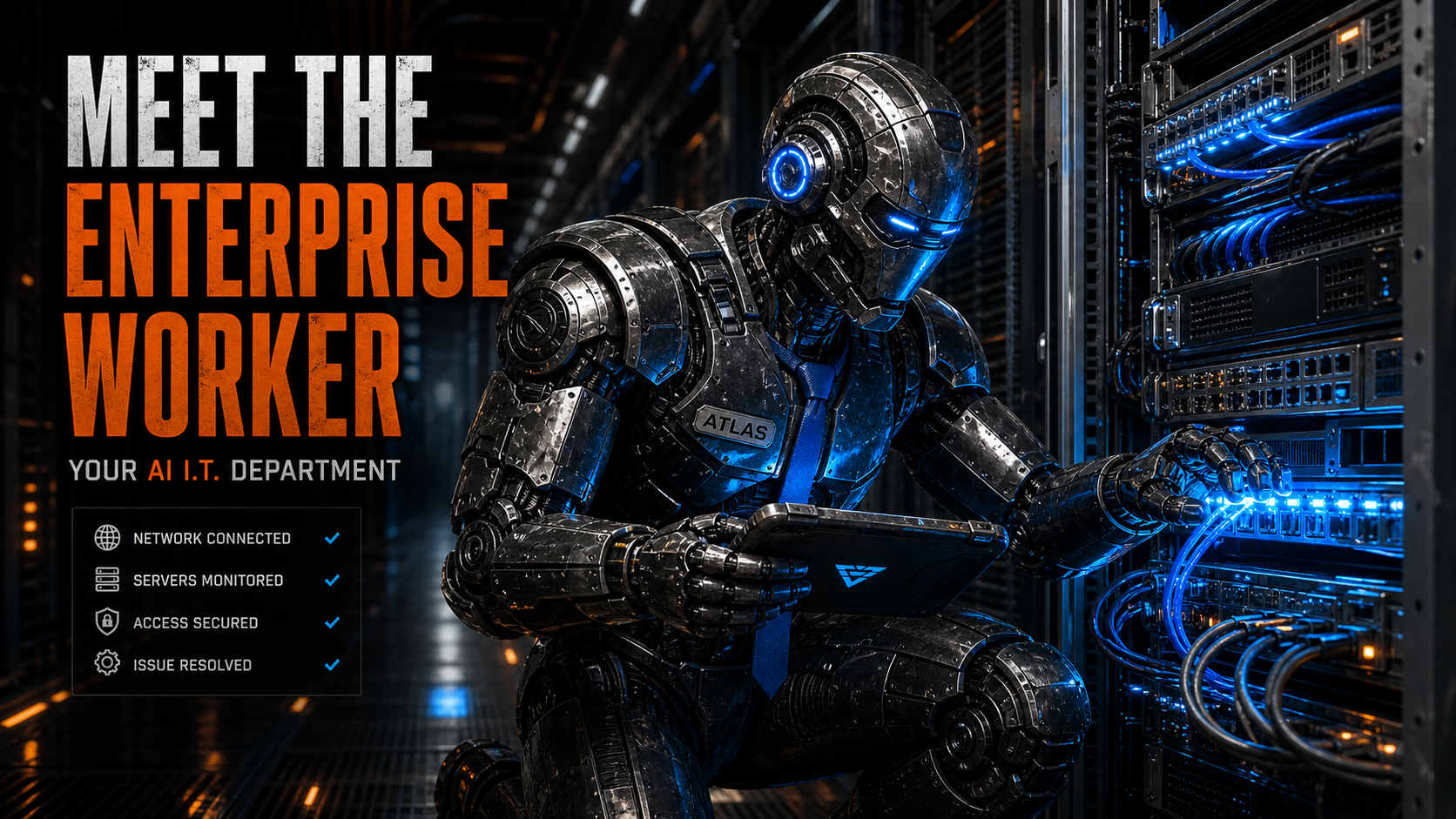
Meet the AI I.T. department.
One job, done better than any generalist
An enterprise worker isn't a chatbot that answers anything. It's a specialist. In a big company, IT isn't a side duty — it's a department, because one unpatched server or one dead email system can cost more in a morning than the department costs in a year.
Atlas is that department, compressed into a single worker.
Atlas doesn't "help with tech." Atlas runs the infrastructure — continuously, around the clock, every day, including the days you'd rather not think about it. The 3 AM backup that failed. The certificate that expires on a holiday weekend. The update that breaks something the moment it lands. Someone is always watching, always checking, always fixing the quiet failures before they become loud ones — without making you the help desk.
The failures that never make the news
The classic small-business IT loop looks like this: something breaks → nobody notices → customers notice → you find out from an angry voicemail → you spend the afternoon on hold with a support line → you pay someone to fix it tomorrow.
Atlas runs the loop the other way. It watches the systems that matter — email, payments, backups, uptime, security — and it notices the small signs before they become big problems. The disk that's 91% full isn't an emergency today. It's an emergency in three weeks, and Atlas flags it now, while fixing it is still a five-minute job instead of a Friday-night rebuild.
And when something does break, Atlas has already captured the "before" — what changed, when, and what the system looked like right before it failed. That's the difference between a two-hour fix and a two-day investigation: the timeline is already written.
The part people don't expect: it fixes the boring stuff too
Nobody builds a business around resetting passwords and clearing print queues. But those little tasks are exactly what eats an owner's week — the "quick" things that are never quick. Atlas handles the whole long tail of IT: the account that needs unlocking, the software that needs updating, the device that needs reconnecting, the email that needs setting up on a new phone. Each one is small. Together, they're a full-time job that no one was doing.
The human stays in charge of the decisions that matter — the big purchase, the security call, the migration, the anything-that-costs-real-money. Atlas does the work, keeps the receipts, and brings the owner a short list: here's what I fixed, here's what I recommend, here's what needs your yes.
The steady hand on the infrastructure
Atlas isn't about replacing your IT person — it's about making sure the technology keeps running when you can't watch it, because the technology never stops. Updates get applied on schedule. Backups get verified, not just scheduled. Access gets tracked. The little fires get put out while they're still little. And when something genuinely needs a specialist, Atlas knows the difference between "I can fix this" and "this needs a human," and it escalates cleanly instead of guessing.
Your people stay focused on the work. Your customers stay connected. And you stop being the unpaid help desk for a business that's trying to grow.
Why this is an Enterprise Worker, not an app
An app doesn't watch your infrastructure at 3 AM. An app doesn't notice that the backup has been failing for six days. An app sits in a folder and waits for you to remember it exists.
Atlas is a worker. It has a job, it does the job, and it reports. Like every worker in the Armory Forge Systems fleet, it's built to be one department in a workforce that scales as your business grows — start with one worker doing one job, and add more as you need them.
The businesses that win aren't the ones that never have an IT problem. They're the ones that have someone watching the systems — before the systems fail.
You imagine. We build. To the victor, the spoils.