The Forge — Armory Forge Systems — Signet Article #045
Something changed this year, and if you run a small business you've probably felt it without having a name for it.
Using AI is normal. Talking about using it is not.
This month, Business Insider took a long look at Anthropic's push to sell Claude to small businesses — and at the pushback owners are getting. Steve Zumoff runs a tiki bar in Pittsburgh called Spork Island Trading Co. He posted a sign out front that had been designed with AI. According to Zumoff, that earned him several one-star reviews on the bar's Google page.
Meanwhile, in Fleet, England, the café Zenchai posted on Instagram that it would not use generative AI for its posters. The director, Monz Islam, told Business Insider he made the post after younger customers complained about other cafés' AI-generated artwork. Even a human-made design in a cheap tool read as more "authentic" to them.
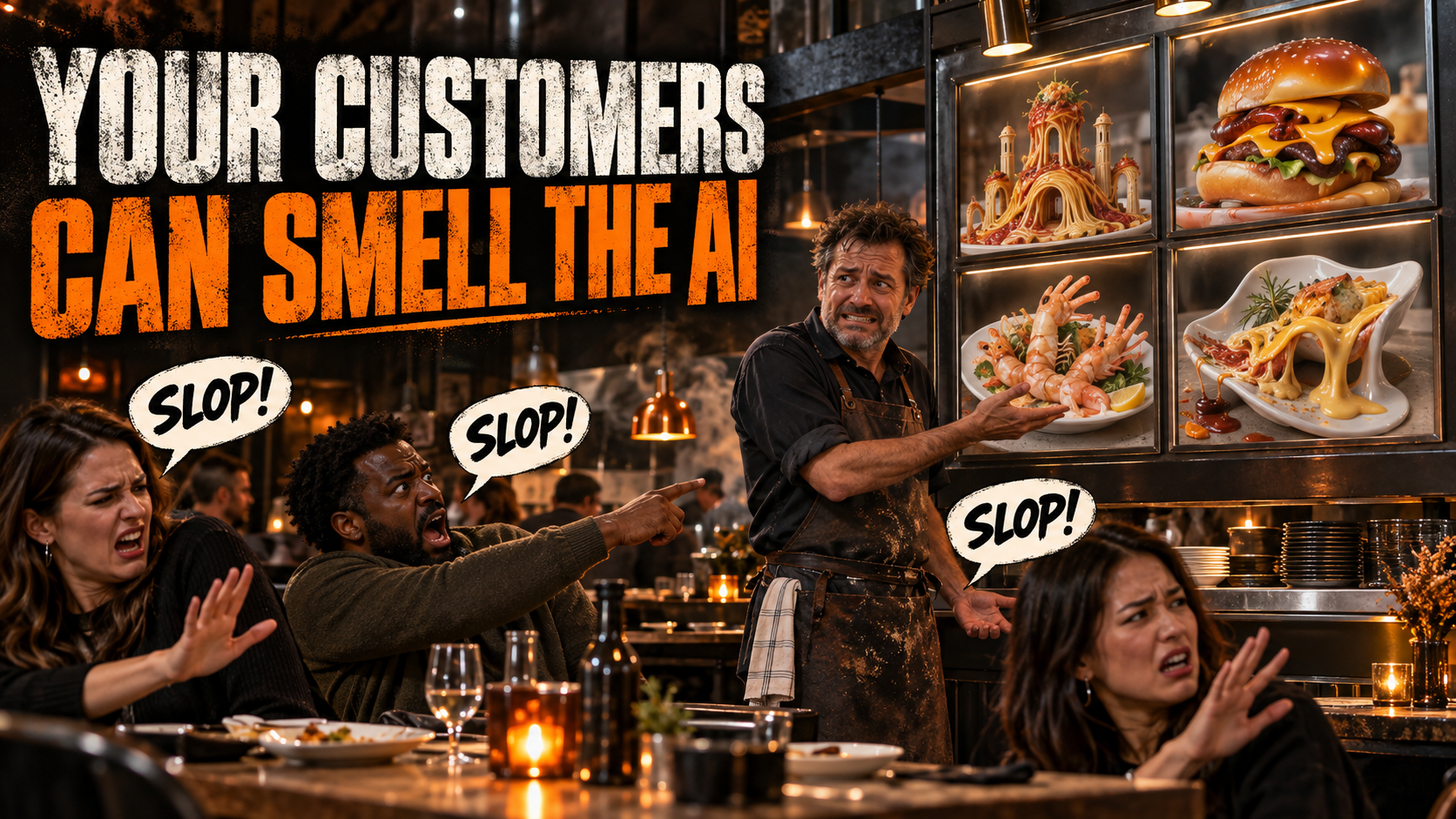
Two stories, opposite moves, same underlying message: your customers are not reacting to AI. They're reacting to AI they can see.
The money is pouring into your neighborhood
It's worth understanding why this is even a story. The labs want you.
Anthropic launched a Claude for Small Business plugin in May. The company says it has since passed 900,000 installations, and this week it added plugins from Shopify, Stripe, and Zoom. Anthropic's head of US small and medium business, Lina Ochman, calls the tool "an agentic starter pack." The company is running half-day workshops around the country — roughly 100 owners per stop in cities like Chicago, Baton Rouge, and San Jose — and last week started training "Approved Claude SMB Trainers," who commit to hosting five workshops of their own by year's end. OpenAI has its own small-business program. The two biggest AI companies on earth are now competing for the same plumbers, cafés, and HVAC shops.
That matters because you are about to be sold to aggressively for the next two years, and some of that selling will be bad. The numbers Anthropic is chasing make the reason obvious: small businesses employ more than 45% of private-sector workers and account for roughly 44% of US GDP, per the Small Business Administration.
What owners are actually doing with it
Here's the more useful finding, buried under the hype: most of them are using AI for themselves, not for their customers.
Anthropic's Ochman told Business Insider that after traveling the country she found most owners were "chatting with AI tools and not yet letting them automate large chunks of their business." The three things they asked about weren't strategy. They were accuracy, getting hacked, and not knowing where to start.
The data agrees that the automation is still shallow. The U.S. Chamber of Commerce Foundation's Main Street AI Monitor, run with Ipsos in May, found that half of workers at small businesses use AI at work — but 64% of that use is personal productivity: drafting, summarizing, brainstorming. Only 26% applied it to recurring tasks, and just 6% used it to automate a workflow with minimal human involvement.
So the picture in 2026 is this: adoption is high, comfort is low, and almost nobody has handed a machine a real job yet. The owners who figured out the first part — drafting emails, writing posts — are now stuck in the dangerous middle: AI that shows up in everything the customer sees, doing work the customer can spot.
Front of house versus back of house
Restaurant people already have the right vocabulary for this. Front of house is what the guest experiences. Back of house is what makes it possible.
The backlash is entirely a front-of-house problem. It's about generated signage, generated menu art, generated captions, generated voices on the phone. Nobody has ever left a one-star review because their accountant used accounting software. Nobody boycotts a plumber for using a spreadsheet. Customers judge the parts they can perceive, and they've gotten good at perceiving AI in exactly those places.
Which means the backlash isn't a reason to wait on AI. It's a map. It tells you, with unusual precision, which work to hand over and which work to keep.
Back of house — the phone that gets answered at 6:40 PM while you're still on a ladder. The quote that goes out and then actually gets followed up. The appointment reminders. The intake form. The invoice that chases itself politely. The support question answered at 9 PM on a Saturday. The monthly numbers. None of this is visible to a customer, all of it is measurable to you, and it's where the hours and the money actually leak.
Front of house — the conversation. The handshake. The judgment call on a weird job. The relationship. Keep that yours. If you do put AI in front of customers, own it and keep a human on it. Even Anthropic's own small-business lead draws the line there: Ochman said she doesn't steer owners toward Claude for banking and legal work, and put it plainly — "Claude will get you 95% of the way there, but the human and the expert stays in the loop."
That's not a disclaimer. That's the design principle.
What this means for the next twelve months
The owners who come out of this period ahead won't be the ones who used the most AI, or the ones who refused it. They'll be the ones who put it where it belongs.
Behind the counter, the argument for AI is boring and overwhelming: a phone that never rings out, a follow-up that never goes quiet, a support line that answers at midnight, a set of books that closes itself. Every one of those is a department a small business usually can't afford to staff — and every one of those is work no customer ever sees.
In front of the counter, the argument for humans doesn't need defending. It's the thing customers are literally asking for.
The backlash is telling you where the line is. Draw it on purpose and it stops being a problem.
Armory Forge Systems builds AI workers that run the departments behind the counter — answering your phone, following up your quotes, handling support, keeping your numbers — so the part your customers actually see stays unmistakably yours. If you want the leverage without the liability, let's talk.