The Forge — Armory Forge Systems — Signet Article #014
You finally did it. You set up an AI assistant for your business. Felt good — modern, efficient, like you're running the future.
Then you asked it a simple question. Something you'd know off the top of your head: "What's our return policy?" or "How much do we charge for a service call?"
And it answered. Confidently. Fluently. Completely wrong.
Not slightly off. Invented. A policy you never had. A price you never charged. Delivered in the same smooth, professional tone it uses when it's right.
This is the number-one complaint we hear about AI: "It doesn't know my business." And honestly? It's not the AI's fault. Out of the box, an AI knows the internet. It doesn't know you.
Why AI Guesses in the First Place
Here's what's actually happening under the hood: an AI like ChatGPT doesn't "look up" answers. It predicts what a good answer sounds like, based on the patterns it learned from a mountain of text.
When the question is something it has seen a million times, that prediction is right. When the question is about your business — your prices, your policies, your customers — it has no data. So it does the only thing it can: it makes a confident guess.
That's what the tech world calls a hallucination. The AI isn't lying to you — it's filling a blank with whatever sounds most plausible. For trivia, that's charming. For your return policy, your quotes, and your customer accounts, it's a liability.
The Fix: Give the AI Your Stuff
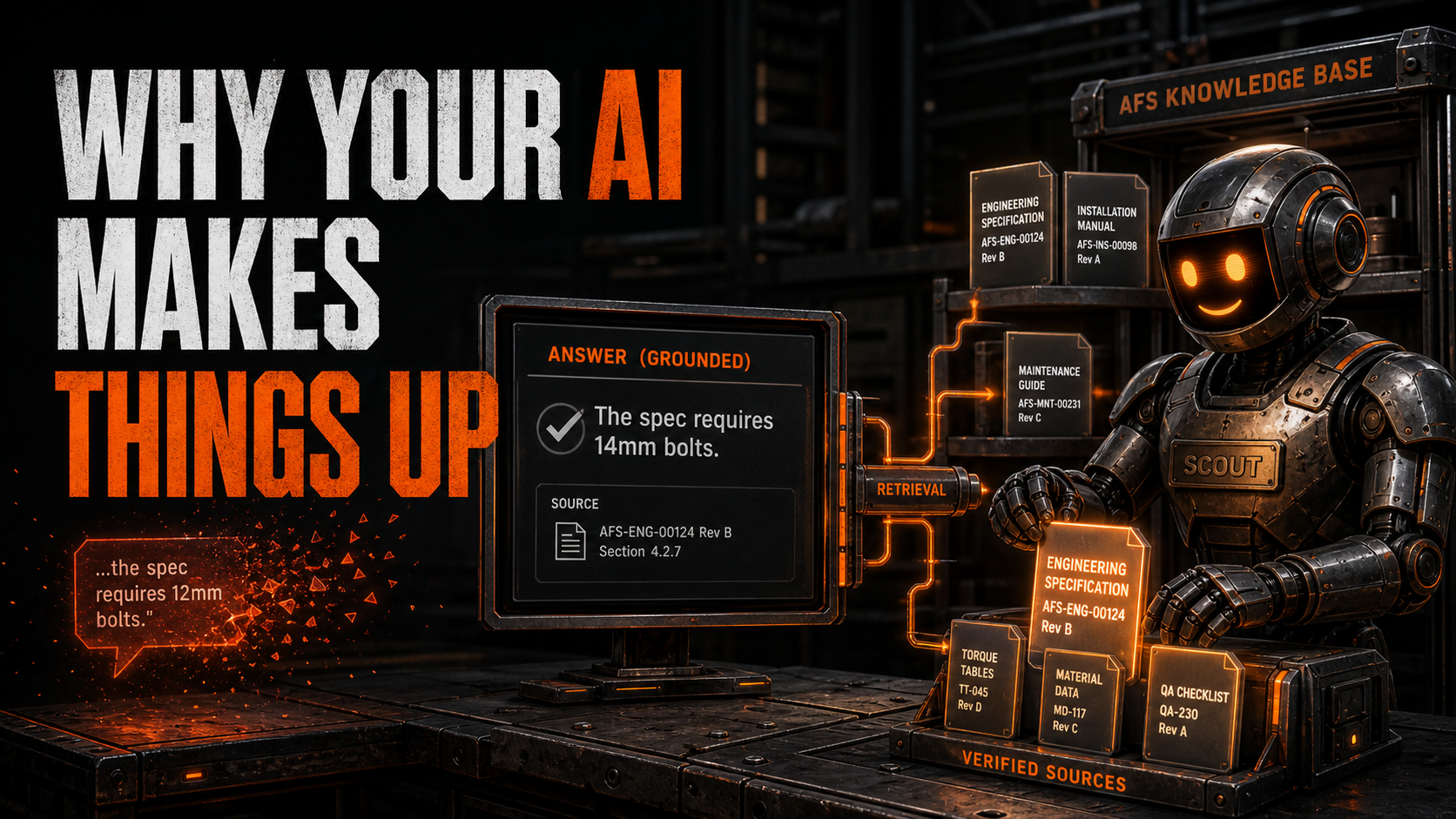
The fix isn't a smarter model. It's giving your AI access to your actual information — and making it check that information before it answers.
That's what RAG is. The name is Retrieval-Augmented Generation, and it sounds far more intimidating than it is. The idea is simple:
"Before the AI answers, it searches your real documents and data, pulls out the relevant pieces, and answers from those — not from a guess."
Think of it like a librarian. A bad librarian answers your question from memory — and when they don't know, they improvise. A good librarian walks to the shelf, pulls the actual book, and reads you the answer. Same librarian, same brain — but now the answer comes from the source, and it's right.
Your AI becomes the good librarian. Your manuals, price lists, policies, and records become the shelves it searches before it speaks.
What That Unlocks for Your Business
1. Customer service that quotes your real policy
Ask the AI about returns, warranties, or scheduling, and it answers from your actual written policies — not from whatever it thinks a business like yours probably says.
2. Sales and quoting off your real price list
"How much do you charge for X?" gets answered with your real numbers, in your real tiers — even in the middle of a conversation with a prospect who's ready to buy.
3. Your team stops being a search engine
Every business has the same silent tax: employees asking the owner the same questions every week — "what's the procedure for this?" "where do we find that?" Point them at an AI that's read your SOPs, and the answer's there in seconds.
4. Answers grounded in your CRM and records
"What's the status on the Acme account?" — answered from your actual CRM data, with the source right there to verify. The AI can point at the record instead of inventing a status.
What RAG Is NOT
Let's clear up two myths before they cost you money.
It's not retraining the AI. You don't need data scientists or a multi-million-dollar model build. RAG works with the AI you already have — it just adds your data to the equation.
It's not a magic box. Your data has to be organized enough to search, and the system has to be built and wired correctly. That's the actual work — and it's exactly the kind of work a good automation partner exists to do.
The Honest Section
Garbage in, garbage out — RAG doesn't fix messy records, it just makes them searchable. If your files are chaos, your AI will confidently surface chaos. That's a data-cleaning problem, and it's worth solving anyway.
And RAG makes the AI reliable, not omniscient. For judgment calls — the big pricing decisions, the sensitive customer conversations — keep a human in the loop. The AI's job is to stop making things up. Yours is still to decide.
Does This Sound Like Your Setup?
A few honest questions:
- Have you ever watched an AI confidently give a customer the wrong answer about your business?
- Do you or your team re-answer the same questions about policies and procedures every single week?
- Would you trust your AI to quote a real price to a real customer right now?
- Do you have manuals, SOPs, or price lists sitting in files that your AI has never read?
- Have you quietly decided AI "isn't ready for your business" after one bad experience?
If you nodded to any of those, the problem isn't AI. It's that nobody connected the AI to your business yet.
The good news: the technology that fixes this isn't experimental. It's the same thing powering serious businesses right now — and the setup is a project, not a research program.
Want to see what your AI could answer once it actually knows your business? The Armorer can walk you through how RAG would fit your operation — no pressure, just answers.