The Forge — Armory Forge Systems — Signet Article #044
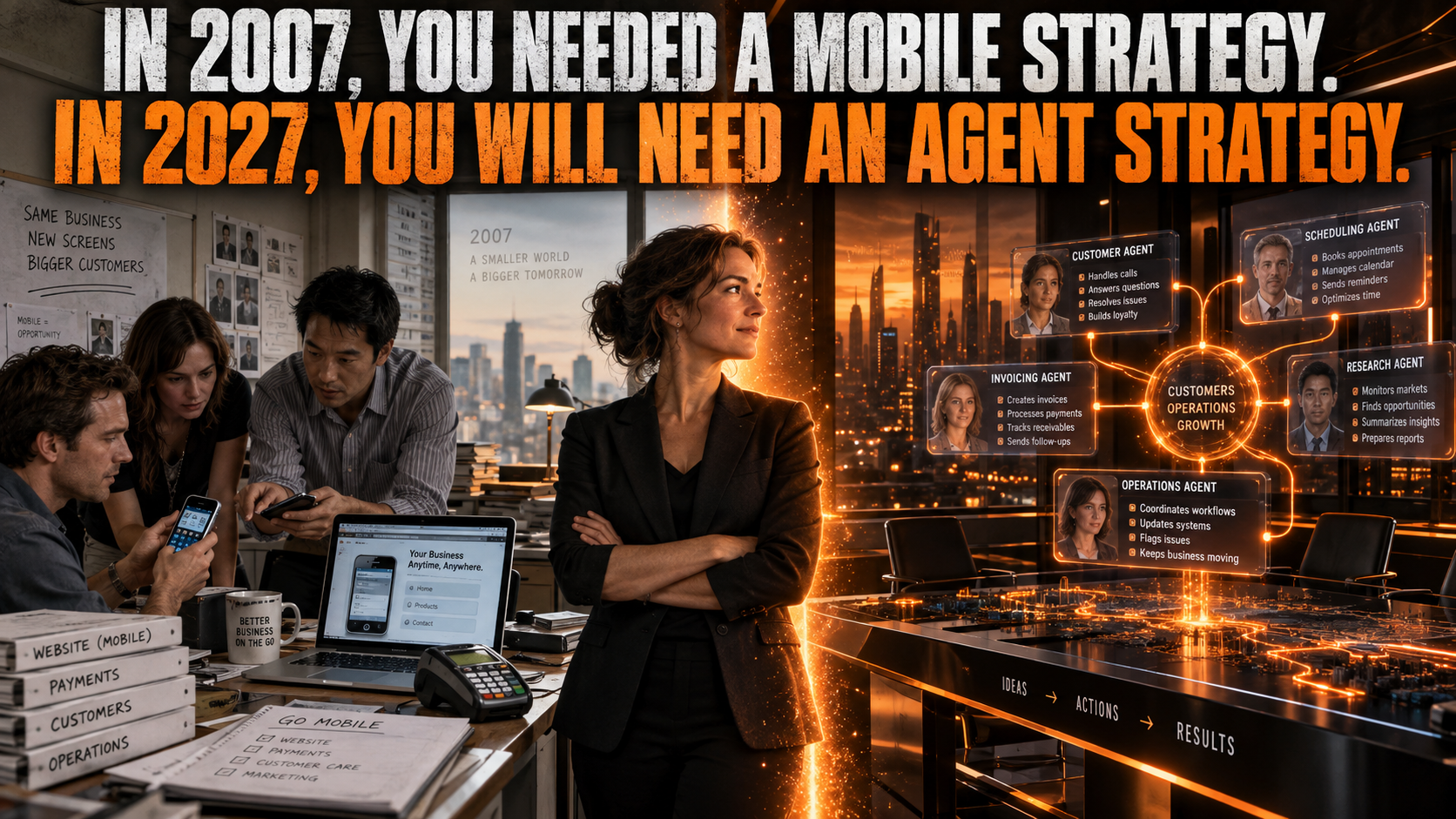
In January 2007, Steve Jobs held up a phone and told the world it was three products in one. Most businesses looked at it and did nothing, because it looked like a gadget for people who wanted a nicer phone.
That was a reasonable read. It was also the most expensive read of the decade.
Here's what actually happened with mobile. In October 2016, nine years after the iPhone, mobile and tablet devices passed desktop for the first time in worldwide internet usage — 51.3% to 48.7%, according to StatCounter. There was no single day when anyone's customers stopped being desktop customers. It happened gradually, and then it was simply how the world worked.
The companies that came out of that shift ahead weren't the ones who predicted it. They were the ones who noticed early, moved early, and — this is the part people skip — understood what the shift actually was.
What a "mobile strategy" really meant
Ask anyone in 2009 what a mobile strategy was and you'd have gotten a list of deliverables. An app. A mobile site. A QR code, if it was a bad year.
But the companies that won didn't win because they shipped an app. They won because they answered a harder question: what does our business look like when the customer's front door is a phone? Different hours. Different expectations. Different competitors. A different definition of "showing up."
The ones that never asked it are the ones we tell stories about. By 2010 it was obvious Nokia had missed the shift toward apps that Apple had pioneered, and that BlackBerry had misread the phone as a communications device when it was becoming a multimedia one — that's INSEAD's own post-mortem, not a cheap shot from the cheap seats. Stephen Elop, the CEO Microsoft installed to sell the wreckage, summed it up better than any consultant could: "We didn't do anything wrong, but somehow, we lost."
They did everything right inside a world that had already been replaced.
The same curve, running faster
Now the analogous shift is agents, and the timeline is compressed.
In November 2024, Anthropic released the Model Context Protocol — an open standard for connecting AI systems to the tools and data they need to actually do work. OpenAI adopted it in March 2025. Google DeepMind followed in April. By December 2025 it had been donated to the Linux Foundation's new Agentic AI Foundation, and the public registry of servers had crossed 10,000. One company's internal plumbing became industry infrastructure in about thirteen months.
That is not how standards normally move. It's how a market moves when it's scared of being late.
The forecasts describe the same slope. Gartner projects that by 2028, 33% of enterprise software applications will include agentic AI — up from less than 1% in 2024 — and that agentic AI will make at least 15% of day-to-day work decisions autonomously, up from effectively zero. Apple, the most mainstream technology company on earth, now describes a desktop computer in its own press materials as an "always-on agentic device."
And the adoption gap is closing faster than it did last time. McKinsey's 2026 survey found 40% of large organizations scaling AI agents, up from 27% a year earlier, while smaller organizations sat flat at 22%. The Census Bureau's Business Trends and Outlook Survey has overall AI use running between 17% and 20% through the first half of this year — with expected use only about three points ahead of actual use. Owners have stopped forecasting leaps they don't take.
The number that should get your attention
Gartner's other prediction is the one worth memorizing: more than 40% of agentic AI projects will be canceled by the end of 2027.
That sounds like a reason to wait. It isn't. Read why the projects die, in Gartner's own words: agents pursued where there's no clear return, and agents bolted onto legacy workflows that were never rethought. In other words, the 40% are the people who bought the thing without changing the thing.
That is the 2007 mistake wearing new clothes. Buying a tool and calling it a strategy.
What an agent strategy is not
It is not a chatbot on your website. It is not a pilot with your IT guy. It is not the tool your vendor of the month is selling.
An agent strategy is a ranked list of work you intend to hand to a machine, and an honest answer about which work you never will.
That's a decision about your business, not about technology. It's the same decision the mobile era demanded: not "what can we build," but "what are we now."
How to actually make the call
- Pick work, not tools. The unit of an agent strategy is a job, not a product. "Answer every call that comes in after 5 PM" is a strategy. "Deploy AI" is a purchase order.
- Split the work into what customers feel and what they don't. Where the work is invisible to the customer — taking the call, chasing the quote, confirming the appointment, answering the same question for the fortieth time, closing the month's books — be aggressive. That's where the hours leak and where nobody has an opinion about how it's done. Where the work is the customer's experience, be deliberate and keep a human in it.
- Integrate, don't bolt on. The 40% graveyard is full of agents stapled to a process that was designed for a person and a clipboard. If the workflow doesn't change, the agent just adds a layer to manage.
- Measure hours and dollars, not enthusiasm. The metric isn't adoption. It's the calls answered that used to ring out, the quotes followed up that used to die in a folder, the Saturday-night question that used to wait until Monday.
- Revisit it every year. What's reasonable to hand over in 2027 will look timid by 2030. A strategy that isn't revisited is just a decision you made once and forgot.
The window is the point
In 2007, having a mobile strategy sounded like a novelty. By 2010 it was a competitive requirement. By 2013 it was table stakes, and the only interesting question was who had built theirs on purpose.
Nobody will hand you a memo the day your industry crosses over. It'll show up as a customer who stopped calling, a competitor whose quotes go out faster than yours, a job you lost to a company you'd never heard of.
The businesses that win the next three years are going to be the ones that asked the hard question early — what does our business look like when a machine does the first pass and the customer never notices? — while it was still early enough for the answer to be a decision instead of a reaction.
You don't need an agent strategy because agents are impressive. You need one because in about two years, not having one will be the thing that looks strange.
Armory Forge Systems builds AI workers that run the departments nobody sees — answering the phone, following up quotes, handling support, keeping the books — so the business keeps moving when you're on a job site. If you want the leverage without the experiment, let's talk.