You imagine. We build. To the victor, the spoils.
The Forge — Armory Forge Systems — Signet Article #051
On Tuesday, September 29th, the United States government did something no company has done at this scale: it put an AI agent on the front door.
It's called America.gov, and it's now the single point of entry for federal services — one search bar where you can ask anything, from booking a campsite at a national park to replacing a Social Security card. It pulls together information from roughly twenty-nine thousand government websites. It's powered by Google's Gemini and Elon Musk's Grok. The President signed an executive order establishing it on stage at the launch event, and the White House says passport renewal and Medicare enrollment are coming next.
We tried it. It's good. Ask it a question about federal services and it answers in plain language, points you to the right door, and doesn't waste your time. For a government that has spent generations organizing itself around bureaucracy instead of around people — and costs Americans something like ten billion hours a year in federal paperwork — that's a real improvement, and it deserves to be said.
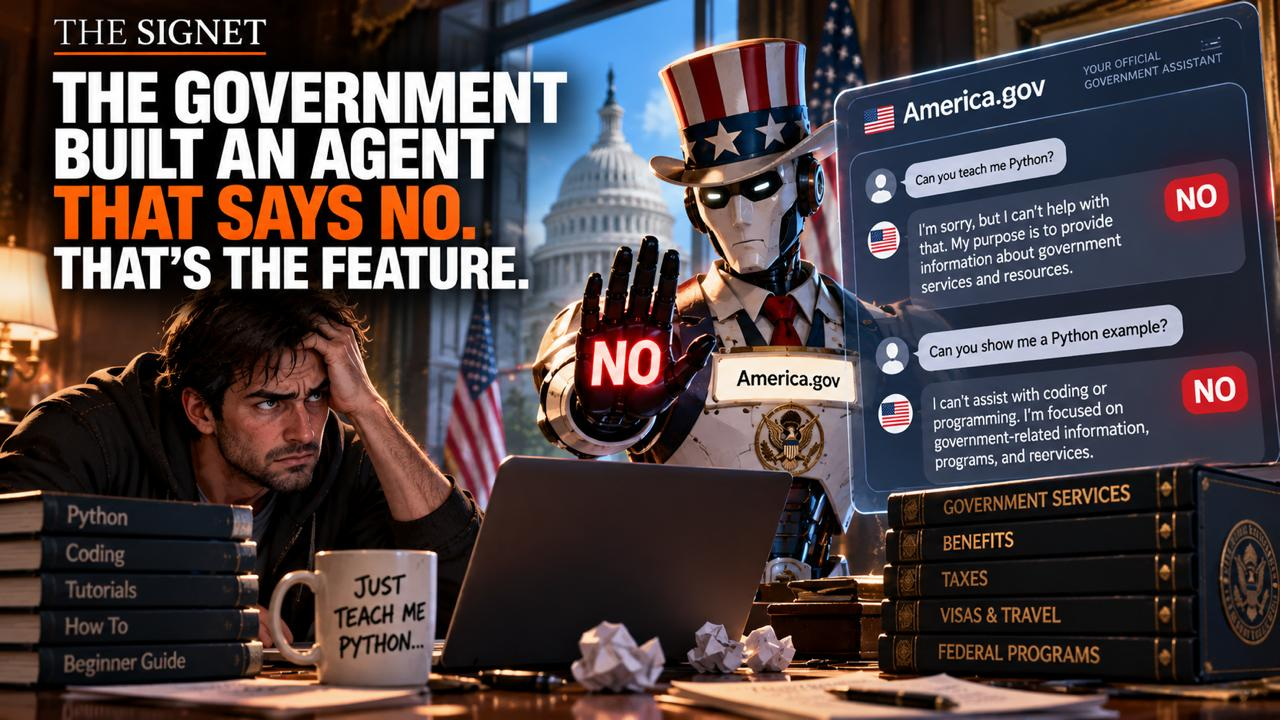
Then we asked it to teach us Python.
It refused.
That refusal is the most interesting thing about the whole deployment, and almost nobody is writing about it.
Joe Gebbia — the U.S. Chief Design Officer and Airbnb co-founder who helped build it — described what's under the hood this way: America.gov is trained specifically on one official source of truth, the United States Government. Not the open internet. Not everything a very capable model happens to know. One source, one job.
So when you ask it to teach you Python, it says no. When you ask it for a federal form, it says yes and hands you the door.
That's a scoped agent, and the scope is the point. A general-purpose assistant that will happily do anything is impressive. A bounded agent that knows exactly what it owns — and declines everything else — is trustworthy. The difference between those two is not a model. It's a decision somebody made, in writing, before the thing went live.
Look at how tightly they drew the line. America.gov covers public-facing federal services that serve more than a hundred thousand people a year and can be done online. And then — this is the part worth stealing — it explicitly excludes IRS tax filing and national-security-sensitive services out of the Department of War and the intelligence community.
That's not a feature list. That's a boundary with reasons attached. They decided what the agent was for, and just as importantly, what it was not for, and they wrote the exclusions down where everyone could see them.
Now compare that to how most businesses adopt AI.
Somebody signs up for a capable agent, connects it to the inbox and the calendar and the CRM and the documents, points it at the whole business, and hopes for the best. No job description. No exclusions. No answer to the question a fourteen-year-old would ask: what is it not allowed to do?
That's not an agent. That's a very smart new employee with keys to every room, no manager, and no onboarding document.
Watch the coverage and you'll notice the question is always the same: which model won? Gemini or Grok? Whose AI is smarter?
The government's answer was a different question entirely: which work does the machine own? Answer that, and the model becomes an implementation detail — you can swap it, mix it, cap its spending, and move on. Skip it, and no model is smart enough to save you.
And notice that even with the boundary drawn, they left the hard part open in public. The White House says you'll be able to renew a passport or enroll in Medicare through the platform — as the launch coverage put it, America.gov is testing whether Americans will trust an AI agent to act, not just answer. That's the real question for every business, not just the government.
When the agent answers, life is easy. When it acts — files the form, moves the money, sends the email — somebody owns the outcome. Who? That question is the difference between an agent you can sleep next to and one you can't.
It isn't that the government has better AI than you do. It doesn't.
It's that they wrote the job description before they deployed. One source of truth. A defined list of services. Named exclusions. A reason for every boundary.
Nobody hands you that document when you buy an agent. It doesn't come in the box, and it never has. You have to decide — on purpose, in advance, in writing — what work the machine owns, what it's forbidden to touch, who reviews what it did, and who's accountable when it acts.
That's the whole job. It's also the thing the bot on the front door of the United States government quietly got right — it says no to Python so that you can trust it with your passport.
Anyone can bolt an agent onto a website. The ones who win decide what it owns — and what it's never allowed to touch. The agent that knows how to say no is the only one you can trust with a yes.
Armory Forge Systems builds AI agents with the scope written down first — one source of truth, named exclusions, real logging, and a human holding the decisions that matter. If you want an agent you can actually trust with a yes, let's talk.