The Forge — Armory Forge Systems — Signet Article #055
Why campaigns are running the first real AI workforce — and what your business should steal from it.
A campaign is the closest thing civilian life has to a startup with a deadline. Enormous budget, tiny team, one product nobody can test until launch day, and a scoreboard that goes public at 8 p.m. on a single night. If you want to know what a technology does to an organization under pressure, watch a campaign adopt it first.
That's what's happening right now, nine days out from the midterms. And it isn't the story most people think it is.
2024 was about fakes. 2026 is about conversations.
Two years ago the AI story in politics was content. A cloned voice on a robocall, a generated photo of a candidate doing something they never did, a fake headline that spread faster than the correction. All of it was artifact — something a human looked at and judged.
This cycle the artifact is the small part. The product is a machine that holds a conversation.
Reporting from NPR in July described platforms that train bots to sound like a candidate, run personalized text conversations with thousands of voters simultaneously, and feed every exchange back into that voter's individual file. Not a broadcast. A two-way sales conversation, at a scale no staff ever could have run, with a memory of what each person said last time.
Now put the numbers next to it. The Wesleyan Media Project, a non-partisan tracker, counted more than $80 million spent on more than 164 AI-generated political ads this season. That's the visible layer. The invisible layer is the one that answers back.
The law is aimed at the wrong object
Thirty-one states now have laws requiring labels on AI-generated political ads. There is no federal law requiring it. That's a patchwork problem, and it's the one everyone keeps describing.
But look at what those laws actually govern: the label on the artifact. A disclaimer on a video. A disclosure in a spot. Rules written when the thing being regulated was something you watch.
Nobody wrote a rule for a machine holding a live conversation in a person's voice, because in 2023 that wasn't a product you could buy. The Center for Democracy and Technology's read on text-based AI outreach lands on the same gap: the practice is outrunning the framework meant to govern it.
You can see the system straining. In October a political group petitioned the FCC for permission to run AI-generated political calls without first getting the receiver's consent — a requirement that currently exists and someone is actively asking to have lifted for political speech. The comment period closed on October 19. The Senate minority leader publicly opposed it, arguing the change would let campaigns put words in an opponent's voice. A ruling could land before the election.
Read the argument carefully, because it tells you where we are: the fight is over consent, not over whether a voter is entitled to know a machine is the one talking. Both questions matter. Only one of them got scheduled.
What a bot does when nobody owns it
In San Francisco this cycle, a state senator running for Congress released a campaign chatbot. It answered roughly 5,000 questions about his opponent — mocking her record, her accent, her citizenship. He pulled it down after the backlash and called it a miss.
The interesting part wasn't the chatbot. It's that a chatbot is only as good as the decisions you point it at. Nobody needed better AI to avoid that outcome. Somebody needed to look at the plan and say: not that, not about her, not in that voice.
That is not a technology failure. It's an assignment failure — the work went to a machine and no human signed their name to the output.
Meanwhile, the voters aren't where you think they are
Here's the part that should make a business owner sit up. Pew's survey of more than 5,000 adults, published October 23, found that just 8% of Americans say they're using AI chatbots to get election information. The inbound-search story is small.
Which means the AI that matters in this cycle isn't the one voters go find. It's the one that goes and finds them — outbound, conversational, in a voice that sounds like an authority figure, with no requirement to announce what it is.
Swap three words and you have the business landscape: the AI that matters isn't the one your customer searches for, it's the one that reaches them first.
The crowd that isn't there
There's a second deployment happening alongside the first, and it's the one that should worry you more.
Scroll a feed this month and you'll find accounts posting about voting — "I already voted for ___," a photo of a smiling local, a first name, a small town. Some are unmistakably synthetic: the platform's own checker slaps an AI label on every image. Others are not. They're older accounts with history and followers, run by a person, with the watermark and the metadata carefully stripped before posting. A machine makes the face and the words; a human makes the judgment call about where to put them.
This isn't folklore. Anthropic's September threat-intelligence report documents AI persona accounts being maintained as persistent characters inside sustained influence operations. Instagram now has a dedicated profile label for accounts that "feature an AI-generated person," and it demotes the ones that don't disclose. Platforms treating fake people as a named product category is the tell: this is industrial now, not improvised.
Here's the trap. Everybody's instinct is to ask a chatbot whether the photo is fake. The Brennan Center tested exactly that — six major chatbots, fourteen AI-generated images, and the results were dismal. In English, only two models caught a majority of the fakes. One of the biggest names in the field identified one out of fourteen. Two of the models failed to identify images their own tools had generated. Only one model bothered to read the embedded provenance metadata. When the researchers re-ran the tests after California's transparency law took effect, performance barely moved.
So both reflexes are broken at once. "The platform flagged it as AI" is not evidence — plenty of real photos get flagged, and plenty of fakes don't. "The detector said it's real" is not evidence either. And metadata can be stripped in seconds, or never present at all if the tool that made the image doesn't embed any.
Which means nobody is going to be rescued by detection. The only thing that survives this is attribution: an agent that is declared as a machine, attached to a named organization, with a human on the hook for what it says. That's the exact opposite of what a persona farm sells. A fake voter's whole value is that no one can trace it to an owner.
Which is also, quietly, the same reason a business should be nervous about the "AI influencers" in its own marketing plan.
Your company is running the same play
Most businesses that have "adopted AI" this year have done exactly what the campaigns did, minus the deadline and minus the scrutiny. A voice agent on the phones. A chat agent on the site. An agent drafting email. An agent answering reviews. Someone bought the capability, wired it to the channel, and moved on — because it worked, and because it was cheap, and because nobody asked who owns what it says.
A campaign has election night to grade it. You don't. You get a slow leak instead: a quote that shouldn't have been given, a promise the schedule can't keep, a customer who got a confident wrong answer and told eleven people, a rep who can't explain why the system said it. No single disaster. Just a quiet tax on the trust you spent years building.
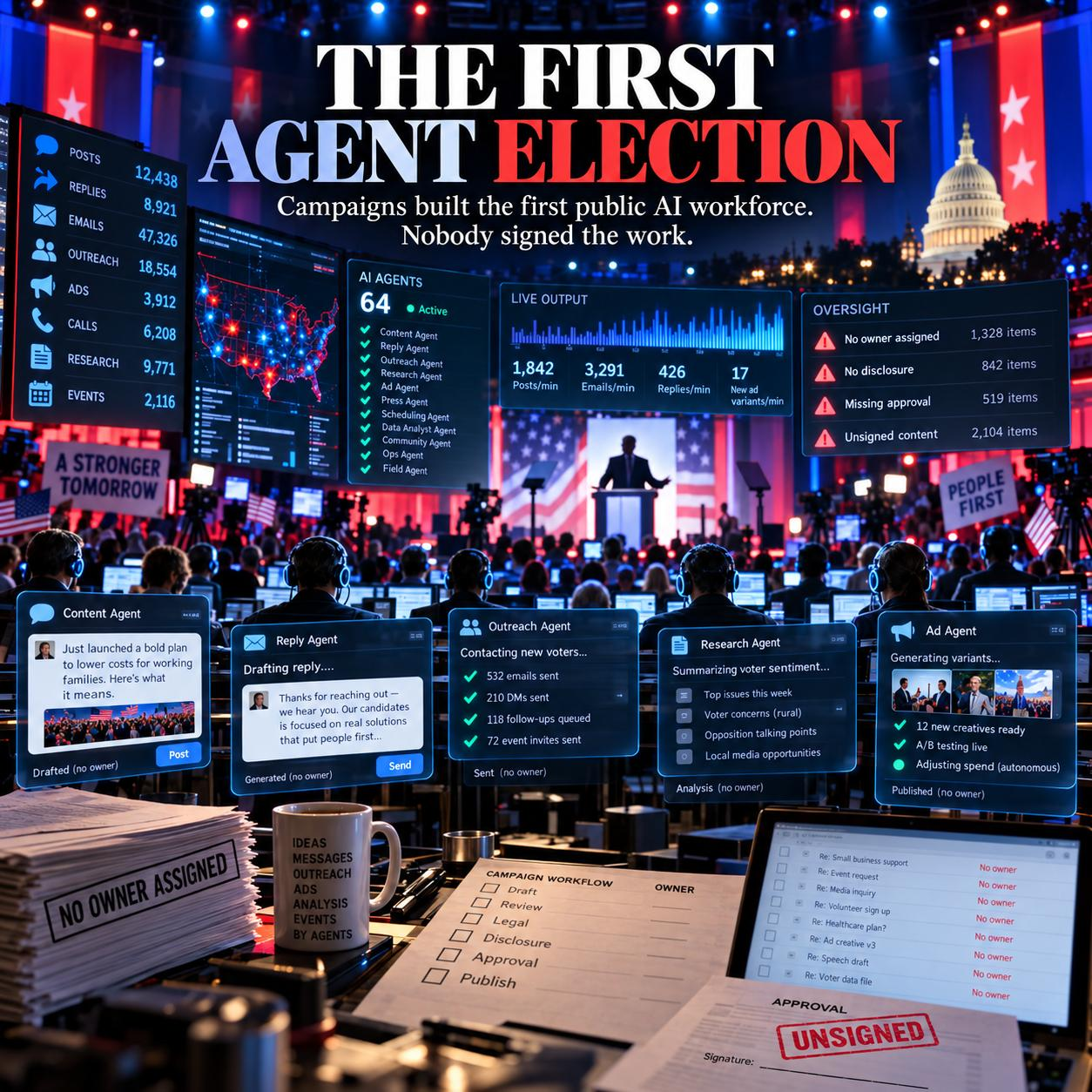
The campaigns aren't failing because they used agents. They're failing at the spot where every business fails: the org chart never existed. Nobody was assigned the work, so nobody was accountable for the work, so the machine's output became the company's word by default.
What an agent strategy actually is
It's not a tool list. It's a ranked list of the work you intend to hand to a machine, with three things attached to every line: an owner, a boundary, and a test that tells you it worked.
- An owner — a human whose name is on that output. If the agent is wrong, that person answers for it.
- A boundary — what it's forbidden to say, promise, or do, written down before deployment, not discovered in a review.
- A test — the measurable change that justified the spend. Calls answered. Quotes sent. Hours returned.
Do that and agents become a department with a manager. Skip it and you've built a campaign bot with an opinion and no supervision, pointed at your customers, with nobody's name on it.
The grade comes November 3
The campaigns are going to teach everyone a lesson in public, and the lesson won't be "AI is dangerous." It'll be that the machine is only as disciplined as the assignment behind it. An agent in a candidate's voice with no owner is the same failure as an agent in a customer's inbox with no owner — one just gets audited by the press, the other gets audited by the market, slower and quieter.
You have a deadline too. It just doesn't announce itself.
Build the org chart first. Then hand over the work.
You imagine. We build. To the victor, the spoils.
Armory Forge Systems decides which work your business should hand to a machine — and then builds the workforce that owns it. Not a chatbot with an opinion: a named agent with an owner, a written boundary, and something measurable to prove it worked. We are your agent strategy. Anyone can automate a task; we build the department that owns it.