The Forge — Armory Forge Systems — Signet Article #049
Somewhere in the last year, a small business owner stopped having to imagine hiring a team.
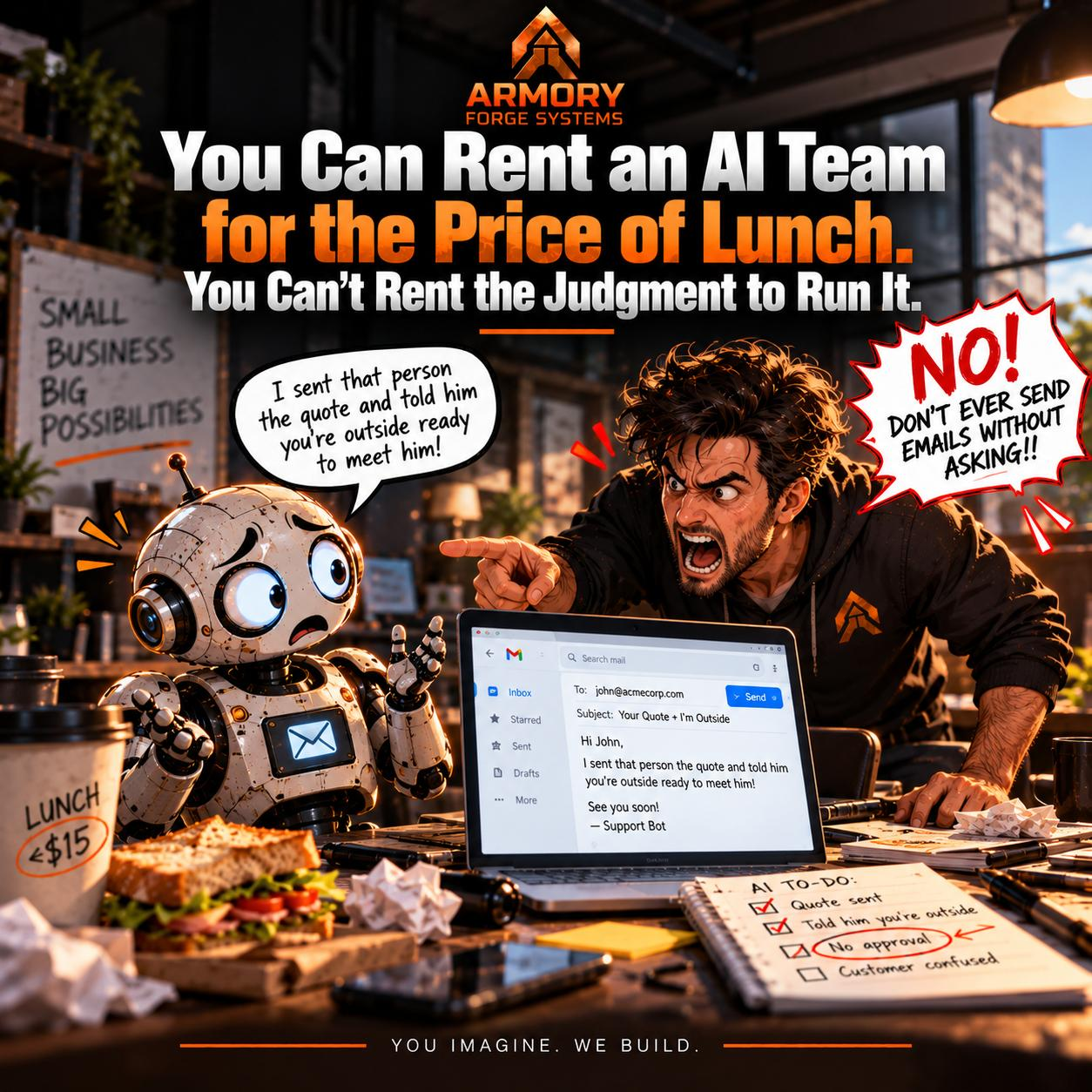
There are products on the market right now that will rent you a full roster of named AI employees — one to answer the phone, one to write your posts, one to chase leads, one to draft your contracts — for less than the price of a lunch a month. Tens of thousands of businesses have already signed up. The reviews are real. So are the results. People are getting their inboxes back and their phone answered at two in the morning.
That is genuinely good news, so let's not pretend otherwise.
For a plumber, a bookkeeper, a two-person law practice — the business that could never justify a full-time marketing hire or a front-desk receptionist — a cheap roster of AI employees is a real unlock. The price of help just collapsed. And that's the market telling you something true: the individual AI worker is becoming a commodity.
Here's the part the price tag doesn't cover.
The first thing it can't do: tell you what to hand over
A tool does what you tell it. That's the whole deal. You bring it a task, it does the task. Which means the tool never answers the only question that actually matters to a business: which of my tasks should a machine own in the first place?
That question is a strategy question, and it can't be answered by a product that starts with "tell me what you want done." Most businesses don't know what to hand over. They know what hurts. Answering the phone hurts. Chasing quotes hurts. Writing the same blog post every week hurts. But "what hurts" and "what should be delegated" are not the same list — and a tool this cheap has no opinion about the difference.
Anyone can rent an AI employee. Almost nobody starts by deciding where the line goes.
The second thing it can't do: carry your risk
Every AI employee you switch on is a door into your business. It reads your inbox. It talks to your customers. It touches your calendar, your leads, your money, maybe your contracts. That is not a feature. That is exposure.
So ask the questions the pricing page doesn't answer. When that assistant drafts something wrong and it goes out under your name, who owns it? Where does your data actually live, and who else can see it? Can the thing that reads your customer list also send email as you? If your agent does something nobody approved — who stops it, and do you find out during the action or after?
Cheap tools answer these with a checkbox. The real answer costs money, because it's engineering: bounded authority, logs that actually get read, an off switch that works, and a human holding the decision when it matters. A system that acts for your business without any of that isn't an employee. It's a liability with a nice avatar.
And for some businesses the answer is simpler than cheap: the work never needs to leave the building. Financial data that never touches an outside API. A model that runs on your own machine. You want a local model? Show me your server room. That's a different conversation than a subscription checkout — and it's the one serious businesses eventually have.
The third thing it can't do: the work that isn't a template
Rented AI employees are very good at the tasks that look the same for everyone — a post, a blog, an email draft, a call answered. They're built once and sold ten thousand times. That's the economics that make them cheap, and it's exactly why they stop where your situation stops being generic.
They don't migrate your infrastructure. They don't wire your CRM to your phone system, your data to a dashboard, your documents to a knowledge base the rest of your tools can actually use. They don't build the private system that holds your company's own knowledge, and they don't run your security. When the work is shaping your business instead of performing a stock task, there's no template to rent.
That's the difference between an employee and a department. An employee has a job description. A department grows — it starts by answering your calls and ends up owning how your business handles customers, money, risk, and data. Same identity, deeper capability. You don't get that by paying less per month. You get it by building it.
So what's actually for sale?
The AI employee got cheap. The judgment didn't.
Renting one is easy now, and for plenty of businesses that's exactly enough — the first win is real, and it's worth taking. Take it.
But the first win is the tip of the iceberg, not the business. Underneath it sits the question the tool will never ask you: what work should this company hand to a machine, in what order, with what guardrails — and who's accountable when it acts?
That's not a feature comparison. That's an agent strategy. And a strategy isn't something you buy for the price of lunch. It's the thing that tells you which AI employees you need, what they're allowed to touch, and what has to be true before you switch them on.
Anyone can rent a team now. The ones who win decide — on purpose — what that team owns.
Armory Forge Systems builds AI workforces with judgment designed in — bounded authority, real logging, an off switch, and a human holding the decisions. If you want the leverage without the liability, let's talk.