The Forge — Armory Forge Systems — Signet Article #058
There's a question worth asking before the answer gets decided for us.
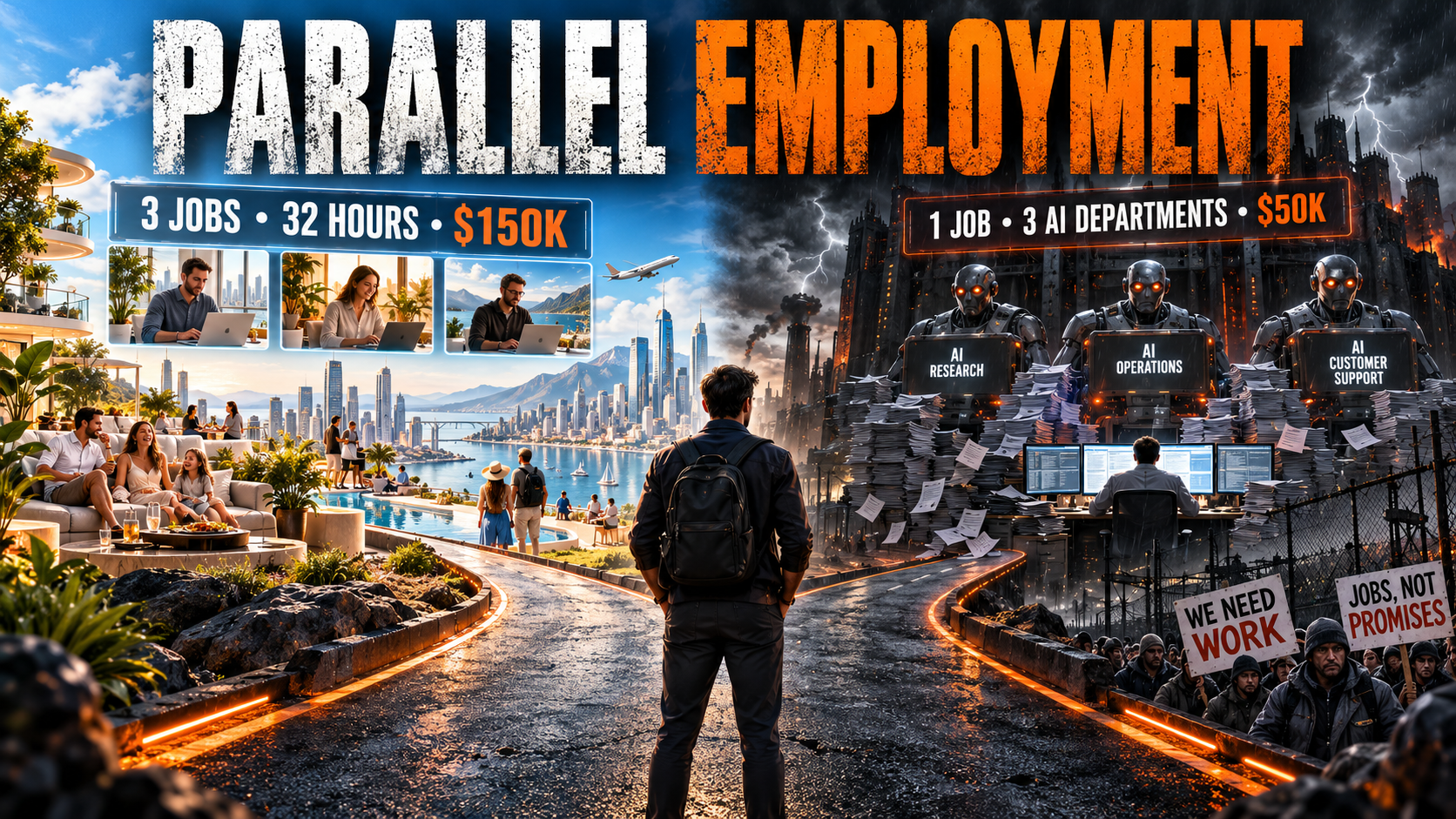
When AI agents can do most of the work of a job, does one human end up working three jobs for three companies and earning three incomes? Or does one company hand that same human five jobs' worth of output and pay them for one?
Same technology. Same productivity gain. Wildly different world.
Most AI writing skips this question entirely, because it's easier to talk about tools than about who gets the money. But this is the actual fork in the road, and we're walking toward it now — not in 2040. The employment structures being written into contracts this year will decide which path gets taken.
The bargain we're leaving
The 40-hour week is not a law of nature. It's a deal, struck in factories a century ago: your employer rents your hours, and output per hour is roughly fixed by human biology.
For most of the last hundred years, that made one human equal one job. Not because people lacked ambition, but because attention didn't subdivide. You can't be a designer, a bookkeeper, and a support agent at the same time — you can only be one of them per hour, and there are only so many hours.
Agents break that equation. They don't break your hours. They break the link between your hours and your output. One person supervising a competent AI workforce can produce the work product of a team, and the ratio isn't fixed — it climbs every few months.
Which raises the question nobody's answer has caught up to. If a human can now oversee the output of five jobs, why would the split be one human, one job, one salary?
Three models, in sequence
It's useful to see this as three stages, because we're moving from one to the next whether or not we name it.
Traditional employment — one human, one job. Your economic identity is your employer. Your value is your hours. Your ceiling is your capacity to do the work personally.
AI-assisted work — one human, multiple agents. This is where most serious operators are now. You still have one job, but you've quietly turned it into a small department. One person plus a fleet produces what used to require five or six. This is the stage where the productivity gain is real, visible, and — importantly — usually captured by whoever owns the employment relationship.
Parallel employment — one human supervising multiple independent AI workforces across different organizations. This is the genuinely new structure. Not freelancing, not consulting, not "side hustle." You hold oversight responsibility for a functioning workforce at Company A, another at Company B, and another at Company C, and you are compensated for the function, not the hours.
This isn't science fiction — it's the consultant, industrialized
Credit where due: parallel employment already exists in narrow, respectable forms. Fractional executives run finance at three companies at once. Board members hold four or five seats. Adjunct faculty teach at three institutions. Consultants carry several clients simultaneously and everyone considers it normal.
What's new is the depth of what one person can carry. A fractional CFO can serve three companies because the work is periodic and the judgment is episodic. An AI-enabled operator can serve three companies because the execution is delegated and their attention is spent only where judgment is genuinely required.
The consultant's trick was always selling judgment instead of hours. Agents just made the ratio absurd. One human's judgment can now cover a workload that used to require a payroll.
The real constraint is not capability. It's HOL.
Here's where this connects to the oversight problem we wrote about previously, and it's the part most parallel-employment optimism skips.
Every organization you supervise generates review work: approvals, exceptions, corrections, decisions only you're authorized to make. In our earlier piece we called the ratio of that required review time to your available oversight time Human Oversight Load (HOL). Below 1, healthy. Above 1, saturated — things go unreviewed and start accruing Automation Debt.
Parallel employment is fundamentally an HOL math problem, and it's brutal:
Your oversight capacity does not scale across employers. It's one nervous system. Three organizations with a fleet each means three sets of exceptions, three sets of context, three sets of standards, and a context-switching tax that is real and expensive. The naive version of parallel employment — one human spread across three employers the way they'd spread across three projects — collapses at exactly the moment it starts to matter.
Which is why the model only works under one condition: most of the output must never reach you. Not filtered carelessly — filtered architecturally, because the agent knows what departs from expectations and what its own authority level permits. Management by exception isn't a nice feature for parallel employment. It's the load-bearing wall. Without it, three organizations is a fantasy and the honest number is one, badly served.
What has to be true — the unglamorous requirements
Parallel employment is not a permission slip. It's an engineering and legal structure with hard requirements. Four of them matter most.
Accountability has to be assigned before anything goes wrong. If an agent makes a decision with financial or legal consequences at Company A, a human is accountable. Which human, under what agreement, with what liability? Professional liability coverage, indemnification, and disclosure requirements all have to be written per organization — you can't be quietly responsible for three companies' errors with one professional insurance policy and a handshake.
Data isolation has to be structural, not promised. This is the absolute wall, and it's where most parallel-employment fantasies die. The same human cannot carry two competing clients' institutional knowledge in one head — law firms solved this a century ago with ethical walls for exactly this reason. Now the wall has to exist in software.
At minimum: separate infrastructure, separate credential scopes, separate memory. No shared agent memory across tenants, no model context that touches Company A's data while serving Company B, no log stream that mixes the two, no "convenient" cross-tenant search. At Armory Forge Systems we build it as one deployment per organization — its own machine, its own agent, its own data boundary — not because it's elegant, but because the alternative is a single breach that ends two client relationships and one career. If a proposed parallel-employment arrangement can't answer "where does the data physically live per tenant," the answer is no.
Contracts have to permit it. Most employment agreements assume your working capacity belongs to one employer, with moonlighting clauses, IP assignment language, and non-compete provisions written for a world where a second job meant divided loyalty. Full parallel employment requires explicit restructuring: scope of function rather than hours, clear conflict rules, and IP ownership that accounts for work produced by agents acting on the employer's behalf. This is genuinely unsettled law, and anyone doing it casually on existing paperwork is taking a risk they probably haven't priced.
Time and value have to be attributable. If you earn from three organizations, how is your oversight time divided, priced, and audited? Flat monthly retainers for a function are cleaner than hourly billing — but they invite the question of whether you're actually delivering the oversight you're paid for. Which, in turn, means logging that's honest enough to survive a dispute.
The fork
Now the uncomfortable part, which the optimistic version of this story leaves out.
Future one: workers capture the gains. Parallel employment normalizes. Skilled operators hold three or four oversight roles, earn multiples of a single salary, and work roughly the same number of hours — because their scarce contribution is judgment, and judgment is what's priced. Income decouples from a single employer, which is real leverage. The 40-hour week doesn't shrink; what changes is how much economic activity happens inside it, and who gets paid for it.
Future two: employers capture the gains. Nothing gets restructured except expectations. One person keeps one job title and one salary, but the output target quietly becomes five jobs' worth, because the agents made it possible and "possible" reads as "reasonable" to whoever sets targets. Headcount doesn't get added back during growth. The mid-level layer — the people whose work was mostly coordination — takes the hit first, because coordination is exactly what the agents took over. The 40-hour week survives too. So does the human, technically. They're just carrying five jobs for the price of one, and the productivity gain never appears on their side of the ledger.
Both futures are technically achievable. Neither requires a breakthrough. Which one we get is not determined by the technology — it's determined by defaults, contracts, and who has leverage when the change lands. That's the honest answer to the question we opened with, and anyone who tells you the technology decides it is selling something.
And there's a third possibility worth naming, because it's probably where we're actually headed: both, unevenly. A stratum of portfolio operators capturing the upside, a much larger group carrying consolidated workloads at flat pay, and a widening gap between them that looks nothing like the old class divide — because this one runs on oversight capacity rather than credentials.
The thesis
The AI revolution probably won't eliminate the 40-hour workweek. That was a labor-movement achievement, and it's durable.
What it can change — dramatically — is how much economic activity one human can oversee inside those 40 hours. Everything follows from that: whether that added activity is paid to the human or harvested by the employer, whether it produces one job well-served or five jobs badly-served, whether it becomes a portfolio income or a quiet consolidation.
Two things are certain. The oversight bottleneck is real, so whoever tries to scale a human across multiple workforces without designing for management by exception will build something that looks fine and quietly fails. And the isolation requirements aren't optional — parallel employment without strict tenant separation isn't a bold new economy, it's a multi-client data breach with extra steps.
The future of work isn't one job or three. It's a design decision about how much a single human should be responsible for, and who pays for the capacity they carry.
Make it deliberately, in writing, this year. The alternative is having it decided for you by a target-setting meeting and a moonlighting clause you never read.
Anyone can hand you agents. The strategy is knowing what one human can actually carry — and refusing to sell them more than that.
You imagine. We build. To the victor, the spoils.
Armory Forge Systems decides which work your business should hand to a machine — and then builds the workforce that owns it, oversight included: what reaches a human, when, and why.