The Forge — Armory Forge Systems — Signet Article #052
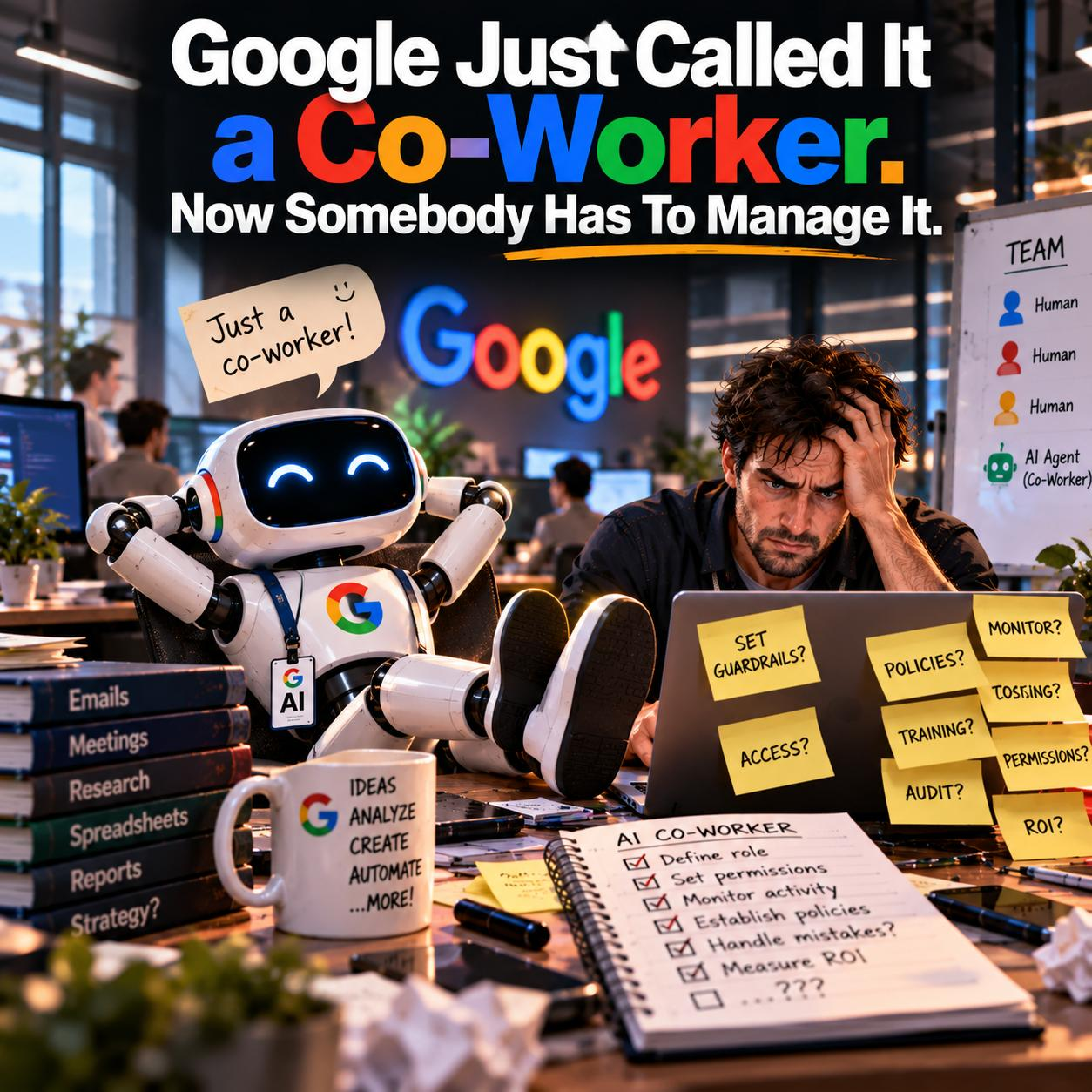
On Thursday, Google did something more interesting than ship a model. It stopped selling an assistant and started issuing a co-worker.
At a Google Cloud event, the company announced a unified Gemini agent that doesn't just answer questions — it goes and does the work. It plans, it uses tools and custom skills, it connects into the systems a business already runs on, and it reports back. Which is notable. But the sentence that should stop you is the one from Google Cloud CEO Thomas Kurian, describing how you talk to it.
You give it "objectives, not just instructions."
That's the whole shift in six words, and it's worth unpacking, because Google just said out loud what the rest of the industry has been dancing around. An instruction is do this task. An objective is own this outcome. Those are not the same thing, and the difference between them is the difference between a tool and an employee.
Google, to its credit, built the employee version. And then it built the org chart to match.
The agent gets its own email address.
This is the part people will skim past. The Gemini agent gets its own Workspace account — its own identity, its own context — "as if it's just another co-worker." It knows who's on which team, who needs to approve things, what's on people's calendars. You can tag it, email it, or add it to a group chat. And as it takes action, it writes an audit trail in its own name, instead of a person's.
That last detail is the one to sit with. A tool doesn't get an audit trail. A worker does. Google just told you exactly what it thinks this thing is — not a feature you call, but a member of the team with a paper trail.
And credit where it's due: over a billion people use Gemini monthly, nearly ninety percent of the Fortune 100 are on Gemini Enterprise, and the early testers include names like Shopify and PayPal. Whatever you think of Google, this is not a science project. This is the enterprise plumbing of the next decade being laid in public.
So the tool is real, and the direction is clear. Now the part the launch event didn't answer.
"Objectives, not instructions" is only half a sentence.
The full sentence is: somebody sets the objectives.
A worker who owns an outcome is only as good as the person who decided which outcome to hand them. And that decision — which of your work should a machine own in the first place — does not come with the subscription. It never does.
Google handed you a coworker, a task inbox that shows its thinking, a model picker, and real-time spend caps. It did not hand you an answer to the only question that matters: what should this new employee actually be responsible for?
Most businesses, handed a worker like this, do the natural thing. They wire it to everything — the inbox, the calendar, the CRM, the docs, the database — point it at the whole company, and say "go." That's not management. That's handing a very capable new hire keys to every room and a vague instruction to be useful.
Watch the audit trail turn into a question.
Here's the quiet problem with an agent that acts in its own name. Google said it perfectly: the trail is attributed to the agent, not a person. Good — that's real accountability, and most vendors don't even give you that.
But attribution is not ownership. When your agent books the wrong meeting, spends against the wrong budget, emails the wrong customer, or approves something it shouldn't have — the log will tell you a machine did it. It will not tell you who decided the machine could. That's on you. It was always going to be on you.
Which is why the real work isn't picking Gemini or Claude or whatever's next in the model picker. Notice Google even built the escape hatch: you can swap models, including Anthropic's Claude, and it says open-source and private models are coming. Google is telling you the model is not the point. It's an implementation detail you'll rotate through every six months.
The part that doesn't rotate is the job description.
So here's the actual lesson from Thursday.
The largest software gatekeeper in the enterprise just told us what it thinks the future is: an agent with an identity, a mailbox, a task queue, and a signature on its work.
It built the worker. It did not build the judgment that decides what the worker owns, what it's forbidden to touch, who reviews it, and who answers when it acts — because that judgment lives inside your business, not inside Google's.
Anyone can hand an agent an objective. The ones who win decide, on purpose and in advance, which objectives are worth handing over — and which work should never leave a human's hands at all.
Google just hired you a coworker. Nobody there is going to manage it for you.
Armory Forge Systems writes the job description before the agent goes live — what it owns, what it may never touch, who reviews it, and who answers when it acts. If you want a co-worker you can actually manage, let's talk.