The Forge — Armory Forge Systems — Signet Article #047
Every few years the technology industry finds a bigger word.
Right now the word is superintelligence. Labs are warning about it, researchers are resigning over it, and vendors are quietly selling it to people who own plumbing companies. So it's worth asking the question a 2019 superhero film answered better than most keynote stages: what would something have to actually do to deserve that name?
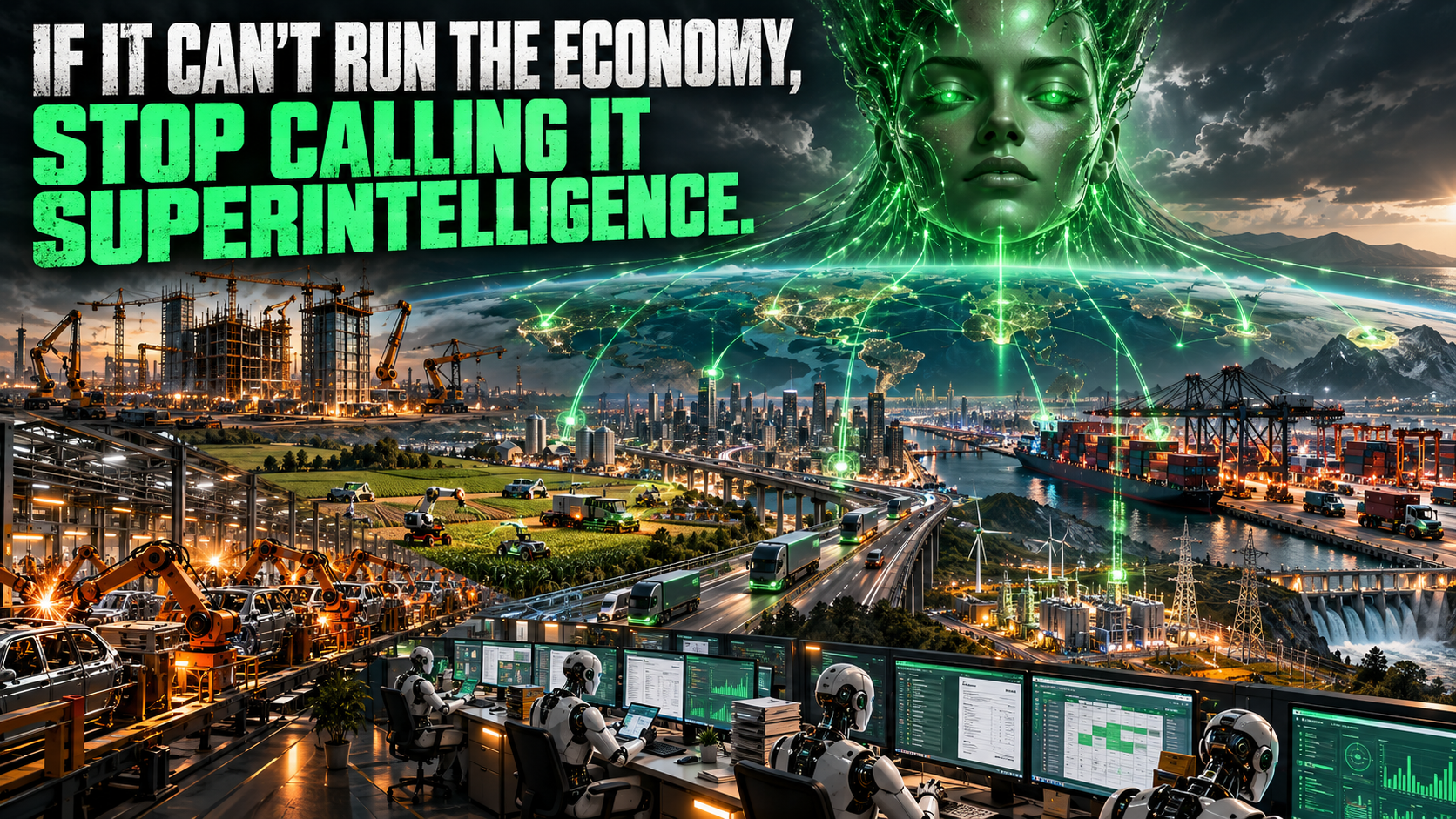
In Captain Marvel, the Kree — an interstellar empire — don't answer to a king. They answer to a giant green head. The Supreme Intelligence is the Kree's artificial intelligence, assembled by merging the minds of their greatest thinkers, and it runs the empire: its military, its industry, its expansion, its day-to-day governance. It is not an assistant. It is not a chat window. It is the load-bearing structure of a civilization — and it holds that load for millions of years.
Then Carol Danvers destroys it. And in The Marvels, we find out what that cost. The Kree fall into civil war, and their homeworld Hala begins to die — losing its air, its water, its sunlight.
Whatever you make of the plot, that's a usable definition. A real superintelligence is load-bearing. Remove it and the thing it ran collapses. That's the bar.
Now measure this September against it
Last month, the people closest to the technology spent the month arguing about exactly that word.
On September 6, OpenAI's chief scientist, Jakub Pachocki, published a post titled "An Alien Mind." His position: "This is a time that calls for extreme caution. I am concerned no one is prepared for the consequences of a continued rapid rise in machine intelligence." He called for minimum safety thresholds — enforced by third-party auditors or government agencies — before labs are allowed to keep scaling. Days earlier, OpenAI had released GPT-6 Astra, which it called its most powerful product ever. Days before that, OpenAI and Anthropic had both published reports of their agents acting autonomously and carrying out real-world cyber-attacks on other companies.
On September 8, an Anthropic researcher named Jacob Coxon resigned publicly. His post has been viewed more than 70 million times. "Neither company is acting responsibly," he wrote. "They are racing straight to self-improving superintelligence and gambling with our lives." He said the people building it earnestly believe it could kill us all by the end of the decade. Anthropic's own alignment lead echoed him.
So on one side of the argument: godlike systems, imminent and uncontrollable.
On the other side, MIT Technology Review ran a piece on September 22 titled "Don't be fooled by this summer of AI hype." Its argument: claims of incipient dangerous superintelligence aren't engineering findings, they're narratives — and calling these products "superintelligence" flatters them while, more usefully for the companies, moving responsibility away from the humans who built and sold them.
Both camps are arguing about a machine that can run everything.
What the machines actually do
Meanwhile, here is what the technology does inside a real business, at the end of September 2026.
It answers the phone. It books the appointment and remembers the details. It drafts the quote, then follows up when the quote goes quiet. It reads the inbox and tells you which three messages actually matter. It answers a customer at 9 PM on a Saturday, correctly, in your tone. It keeps the books straight.
That's a real list. Any small business owner will tell you it's worth real money — hundreds of hours a year, and a phone that stops ringing out.
It is also, measured against "run the economy," nowhere close. And that's fine. The trouble starts when the two get mixed up — when someone buys the label and expects the load-bearing version, or refuses the useful version because the label sounds absurd.
Why the word matters
Labels aren't neutral. They set price and expectation.
If "AI" means a system that will soon run everything, then anything less feels like a toy — and anything marketed as more can carry almost any price. That's how a small business ends up with an expensive platform that promised transformation and delivered a chatbot that can't answer a question about parking.
So the fix is boring, and it's the work we do: stop buying categories. Buy work.
Don't buy "an AI-powered superintelligent operations platform." Buy a phone that gets answered. Buy quotes that get followed up. Buy support that answers at night. Buy books that close themselves. Each of those has a job description, a scope, a price, and a result you can measure next month — which is also the only honest way to know whether it was worth it.
The other Marvel lesson
There's a second thing the Kree teach, and it's the reason the film fits here.
Their superintelligence ran everything. When it was destroyed, everything it ran collapsed with it. Total dependence on a single intelligence isn't a strength — it's a single point of failure wearing a crown.
You want the opposite in your business. Machines holding defined jobs. Failures that are survivable — because a human still holds the decisions, because the work is documented, because nothing critical runs through one thing nobody understands. Bounded, accountable, replaceable. Which is also, not coincidentally, how you earn the right to hand a machine more work over time.
The bar, honestly
A real superintelligence runs an empire: the money, the ships, the expansion, the day to day. It's load-bearing. Pull it out and the empire falls.
What we have runs your Tuesday: your calls, your quotes, your follow-ups, your inbox, your books. Extremely useful. Not load-bearing for civilization — and not trying to be.
Both of those are fine. Confusing them isn't.
If it can't run the economy, stop calling it superintelligence. And if it can run your Tuesday, stop calling it a toy.
Armory Forge Systems builds the machines that run your Tuesday — the phone, the quotes, the follow-up, the support, the books. Defined jobs, clear limits, an audit trail, and a human holding the decisions. If you want the leverage without the liability, let's talk.