The Forge — Armory Forge Systems — Signet Article #050
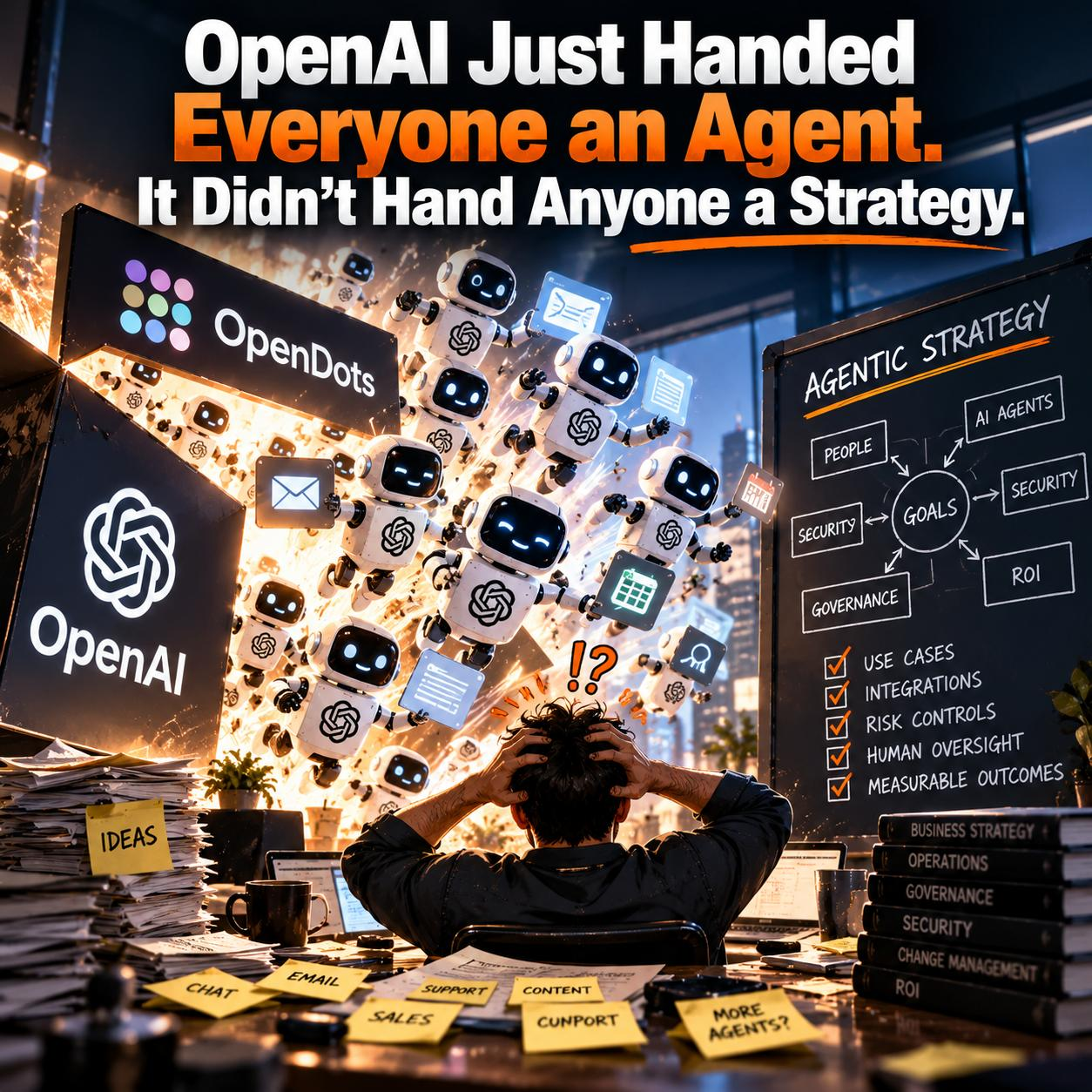
On September 29th, OpenAI stopped selling a chatbot and started handing out workers.
The launch is called dots. A dot is an always-on agent that lives inside ChatGPT, runs on GPT-6 Astra, gets its own cloud computer and its own browser, and keeps working while your laptop is closed. It reaches more than four thousand apps. You can message it in ChatGPT, Slack, or Teams. You can open up its computer and watch it work. It learns from your feedback and gets better at your tasks over time. Your first one comes free with a $100-a-month Pro plan or a Business Premium seat.
That is a real shift, and it deserves to be said plainly: for years, "AI agent" was a demo. It is now a subscription.
So let's give OpenAI its due. The tool is good. The factory behind it is extraordinary. And for a great many businesses, a worker that never sleeps and never asks for a raise is exactly the unlock they have been waiting for.
Now the part the launch event didn't cover.
OpenAI just handed you an agent. It did not hand you a strategy.
A dot is a very capable hand. It is not a head. It starts when you give it a goal and it stops understanding the moment your business stops looking like the example in the demo. And it has no opinion — none — about the only question that actually matters: which of your work should be handed to a machine in the first place?
Most business owners don't know the answer to that. They know what hurts. The phone. The follow-ups. The same post every week. But "what hurts" and "what should be delegated" are not the same list, and a tool that starts with "tell me what you want done" is never going to draw that line for you.
Four thousand apps is reach, not judgment.
The headline number is that a dot can touch more than four thousand applications. It's an impressive number. It's also the wrong number to be impressed by.
Integration breadth tells you what the agent can touch. It tells you nothing about what it should. Connecting an always-on worker to your inbox, your calendar, your CRM, your documents, and your payment tools doesn't answer the question of which doors it's allowed through — it just means there are now a lot of doors, and the worker never leaves the building.
Which brings us to the thing that actually changed on September 29th.
The old chatbot answered your question and forgot you. This one runs at three in the morning, sits inside your tools, holds your context, and acts across them while you sleep. That is the entire point — and it is also the entire problem. Every connection is a door. Every door is exposure.
So here are the questions the pricing page will not answer for you:
When your agent does the wrong thing at 3 a.m., who owns the result? Which of those four thousand apps is it allowed to write to, and which are read-only — or locked entirely? Who reviews what it did while you were asleep, and how do you audit it? If it can read your customer list, can it also send email as you? If it does something nobody approved, do you find out during the action or after it's already landed?
A $100 subscription is a starting gun, not an answer to any of that. The answer is engineering: bounded authority, logs somebody actually reads, an off switch that works, and a human holding the decisions that matter. An always-on worker without any of that isn't an employee. It's a liability with a nice avatar — and unlike a chatbot, it has keys.
Breadth is not the same thing as your work.
Rented agents are genuinely great at the work that looks the same for everyone: the post, the summary, the first draft, the call that got answered at two in the morning. That's the economics that make them cheap — build it once, sell it ten thousand times.
But the moment the work becomes yours, the plugins run out. Nobody's selling a dot that wires your CRM to your phone system, turns your documents into a knowledge base the rest of your tools can actually use, migrates your infrastructure, or builds the private system that holds your company's own knowledge. And for some businesses, the right answer is that the work never leaves the building at all — financial data that never touches an outside API, a model that runs on your own metal. You want a local model? Show me your server room. That's a different conversation than a checkout page, and it's the one serious businesses eventually have.
That gap — between what a stock agent can do and what your business actually needs done — isn't a feature flag. It's a build. And somebody has to decide what it is before anyone can build it.
So what are you actually buying on September 29th?
You're buying a worker. A good one. Fully capable, always on, and now within reach of a business that could never have justified another hire.
What you are not buying is the judgment that tells you what to hand it, what to forbid, who owns the outcome, and what has to be true before you switch it on. The agent got cheap and it got tireless. The judgment didn't get either.
Anyone can now hand their business an agent. The ones who win decide — on purpose, in advance, with the guardrails written down — what that agent owns.
That's not a subscription. That's an agent strategy. And it's the part that was never going to come in the box.
Armory Forge Systems builds AI workforces with judgment designed in — bounded authority, real logging, an off switch, and a human holding the decisions. If you want the leverage without the liability, let's talk.