The Forge — Armory Forge Systems
Every growing business hits this wall. The phone's ringing more than your team can handle. Someone says, "We need to hire another employee."
But is hiring always the right answer? Or is there a better option you haven't considered?
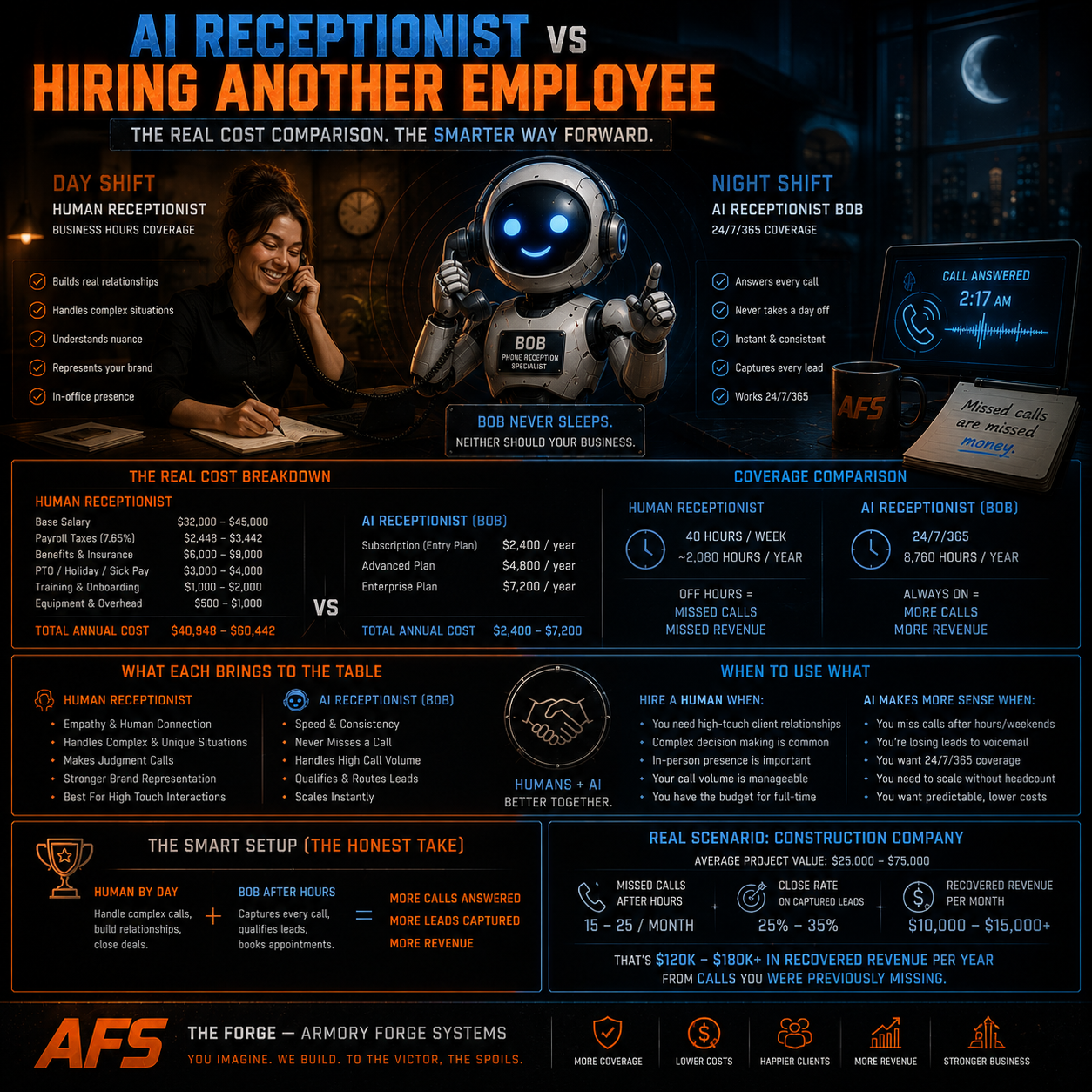
The Real Comparison
Let's look at this honestly. An AI receptionist and a human employee aren't the same thing. They do different jobs in different ways. The right choice depends on what you actually need.
Cost
A full-time receptionist in the US costs:
- Salary: $30,000–$45,000/year
- Payroll taxes + benefits: 20–30% on top
- Training + onboarding: 2–4 weeks at reduced productivity
- Turnover risk: Average receptionist tenure is 18–24 months
Total real cost: $40,000–$60,000/year
An AI receptionist costs:
- Subscription: $200–$600/month
- Setup: One-time configuration
- Ongoing: Zero — no PTO, no sick days, no overtime
Total real cost: $2,400–$7,200/year
That's not a competition. It's a difference of roughly 10x.
Coverage
A human works 8 hours a day, 5 days a week. Maybe 40 hours total. Realistically, they spend maybe 3–4 of those hours actually on the phone.
An AI receptionist covers 24/7/365. No exceptions. It takes every call simultaneously — no hold music, no busy signals, no "can you call back?" It handles after-hours traffic, lunch breaks, weekends, and holidays. Every single time.
Most businesses get 30–40% of their calls outside normal business hours. An employee can't help with those. An AI can.
What They Actually Do
A human receptionist brings warmth, personality, and relationship building. They exercise judgment for complex situations. They handle walk-in traffic and non-phone tasks. Their brand voice adapts naturally.
An AI receptionist brings perfect recall of your services, pricing, and policies. Consistent delivery — every caller gets the same quality. Instant scalability — handles 1 call or 100 simultaneously. Data capture — every call is logged, transcribed, and actionable.
When to Hire a Human
You should hire a receptionist when you need someone to manage a physical front desk or lobby, your calls require deep unstructured conversation (legal counsel, medical triage), you want a team member who grows with the company beyond phone duties, your call volume justifies full-time coverage during business hours, and you have the budget — and the actual work — to keep them busy.
When to Use AI
You should use an AI receptionist when you're a small team where everyone already wears too many hats, calls come in sporadically, you're losing after-hours business because nobody answers, your receptionist spends most of their day doing other work between calls, or you want to test if phone-based lead generation works before committing to a hire.
The Truth Most Vendors Won't Tell You
It's not one or the other.
The best setup for most growing businesses is: human during business hours + AI overflow + AI after hours.
Your receptionist handles walk-ins, complex calls, and relationship building during the day. The AI catches the overflow when they're busy. The AI handles everything after 5 PM and on weekends. The two work together — and you don't need two humans to do it.
The Math
Let's run the numbers for a real scenario.
Scenario: A construction company gets 15–20 calls per day. 5 of those come after hours. Currently, those 5 calls hit voicemail. Maybe 1 in 20 calls back. Maybe 1 converts per month.
With a second hire: $50k/year cost. Answers more calls during the day, but still misses after-hours.
With an AI receptionist: $4.8k/year. Answers every call, including all after-hours. With a warm, professional greeting and instant answers, that conversion rate jumps. Captures 2–3 consultations per month that were going straight to voicemail. At an average project value of $5,000, that's $10,000–$15,000/month in recovered revenue.
The AI pays for itself on the first call it answers that would have gone to voicemail.
The Bottom Line
An AI receptionist isn't a replacement for your team. It's a force multiplier that handles the work your team can't — after hours, during overflow, and in those moments when the phone rings and everyone's busy.
When you look at it that way, the question isn't "AI or human?"
It's "why would you leave money on the table waiting for an answer that already exists?"