The Forge — Armory Forge Systems — Signet Article #012
It's 3:15 PM in July. It's 96 degrees outside, and the air feels like soup.
Somewhere in Florida, a homeowner's AC just stopped blowing cold air. Their house is 88 degrees and climbing. They're sweating, they're frustrated, and they pull out their phone to find an HVAC company.
They call the first one. Busy signal.
They call the second one. It rings... and rings... and rolls to voicemail. "Your call is important to us."
They call the third one. Someone picks up on the second ring and says, "We can have a tech out this afternoon."
That company just earned a customer — not because their prices were better, or their trucks shinier, but because they answered the phone.
The Summer Problem Every HVAC Company Knows
If you run an HVAC company in Florida, none of this is news to you. Summer is a completely different business. Call volume doubles or triples in June, July, and August. Every tech is in the field from sunrise to sunset. And the phone?
The phone keeps ringing.
Here's the uncomfortable math: a missed call isn't just a missed call. It's a customer who calls the next name on Google. In an emergency — and a dead AC in a Florida summer is an emergency — nobody waits on hold. Nobody calls back later. They call the company that answers first.
That's the difference between a $150 service call, a $1,000 repair, or a $10,000 system replacement walking out the door — versus booking with your competitor.
Nobody Dies on Hold — They Just Leave
Here's a phrase you'll never hear a customer say:
"No problem, I'll just wait on hold for 20 minutes in my 90-degree house."
People don't wait. They hang up and move to the next option. And the next company's tech is already pulling into their driveway while your phone is still ringing.
Voicemail doesn't save you either. "We'll call you back" means "we might call you back tonight, after you've already booked someone else." By the time you return that message, the customer's AC is fixed — by your competitor.
The Second Problem: Your Techs Are Busy — Who's Tracking Them?
The phones are only half the story.
While your techs are in the field — on a roof, in a crawlspace, behind a condenser unit — someone has to keep track of where everyone is. Which jobs are done. Who's running late. Which tech is closest to the next call. Whether the part for tomorrow's job is on the truck.
Most companies run this on a whiteboard, a group chat, and hope.
So the real question isn't just "who's answering the phone?" It's "how do you run an operation where the office can keep up with the field — while also answering every call?"
What AI Actually Does Here
Let's be clear about what AI brings to an HVAC company. It's not a robot that fixes air conditioners. It's a system that handles the two things that lose you money right now: the calls you miss and the coordination that slips.
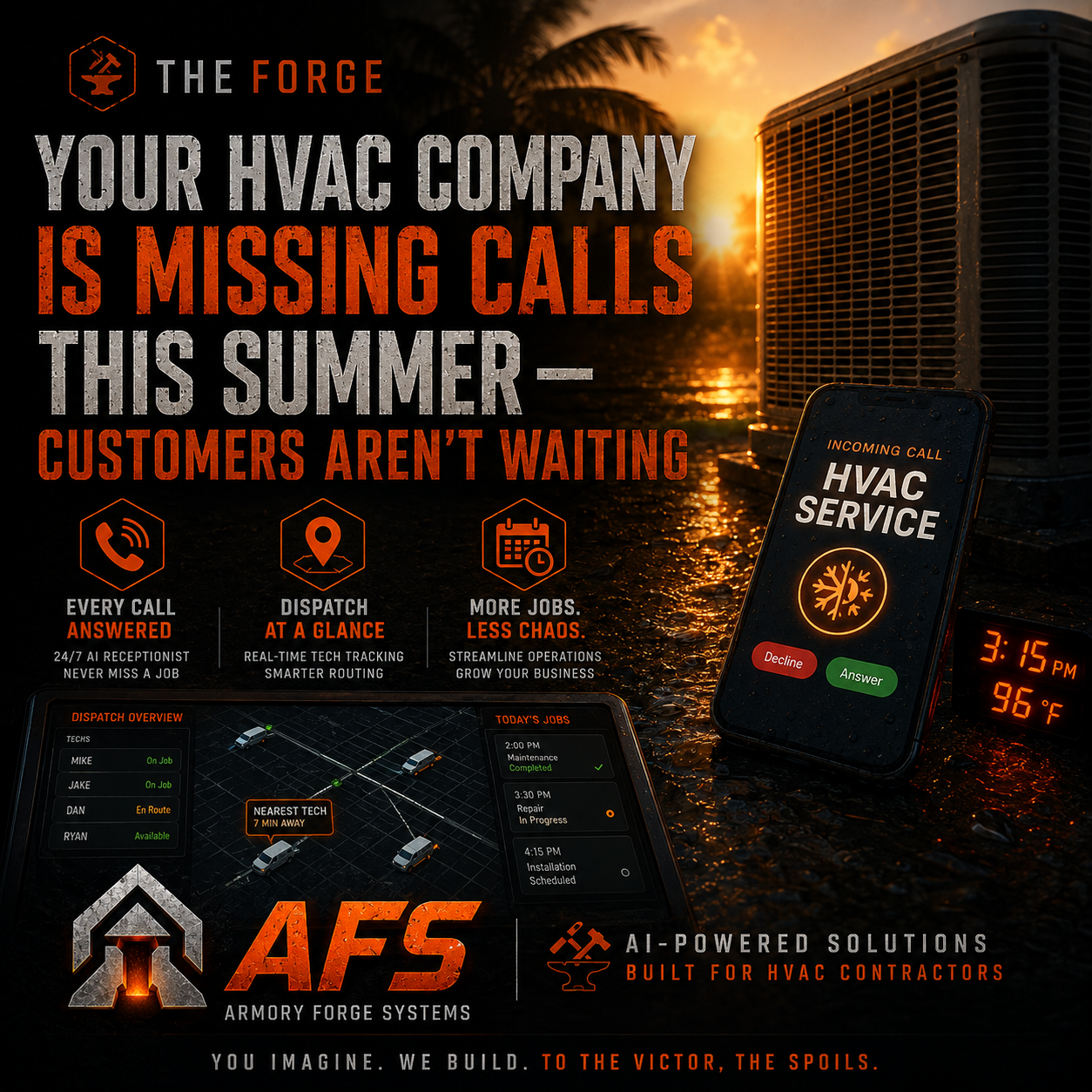
1. Every call gets answered — instantly, 24/7
An AI voice agent picks up on the first ring. No hold music. No phone tree. No "press 1 for sales."
The caller says their AC isn't cooling. The agent asks for their address, what the system is doing, and whether anyone's home — naturally, like a trained receptionist, not a robot.
It books the appointment window, captures the details, and hands the job to your dispatcher as a clean summary. The customer hangs up with a confirmed time instead of a voicemail message. That's the whole difference — they booked with you.
It also covers the calls you never used to get: evenings, weekends, holidays, and the 2 AM emergency. Right now those go to voicemail. With AI, they become appointments.
2. The dispatch picture, at a glance
The same technology that answers calls can track the field: where each tech is, what job they're on, their ETA, and what's next. Instead of a whiteboard and a group chat, you get one screen that shows the whole day.
When a call comes in, you know exactly who's closest and who's free — instead of guessing from memory while the customer waits.
3. The office stops being the bottleneck
You don't need to hire a third or fourth person to handle a summer that's three months long. The AI absorbs the spike. Your existing team focuses on the work that needs a human — the repairs, the quoting, the actual service.
The Honest Section
AI doesn't fix air conditioners. It won't replace your techs, and it shouldn't. What it does is stop the bleeding at the front door — the calls that used to ring out, the customers who used to call someone else, and the dispatch chaos that burned time every single day.
And it's not a magic box. It needs to know your business — your service areas, your pricing, your availability — before it talks to a single customer. That setup is exactly what a good automation partner does: learn your business, then build the system around it.
Does This Sound Like Your Summer?
A few honest questions:
- Do you know how many calls you missed last week?
- Do callers ever complain about hold times?
- Do after-hours calls go straight to voicemail?
- Does your office lose track of who's where during the afternoon rush?
- Have you ever booked a job and thought, "we got lucky — the phone actually rang when we could answer it"?
If you nodded to any of those, the fix isn't more voicemail or a bigger whiteboard. It's making sure every call becomes a booked job — and every tech is exactly where the day needs them.
The good news: this isn't experimental technology. It's running right now, and it's built to handle exactly this kind of seasonal spike.
Curious if this could work for your HVAC company? The Armorer can explain how it would fit your operation — no pressure, just answers.