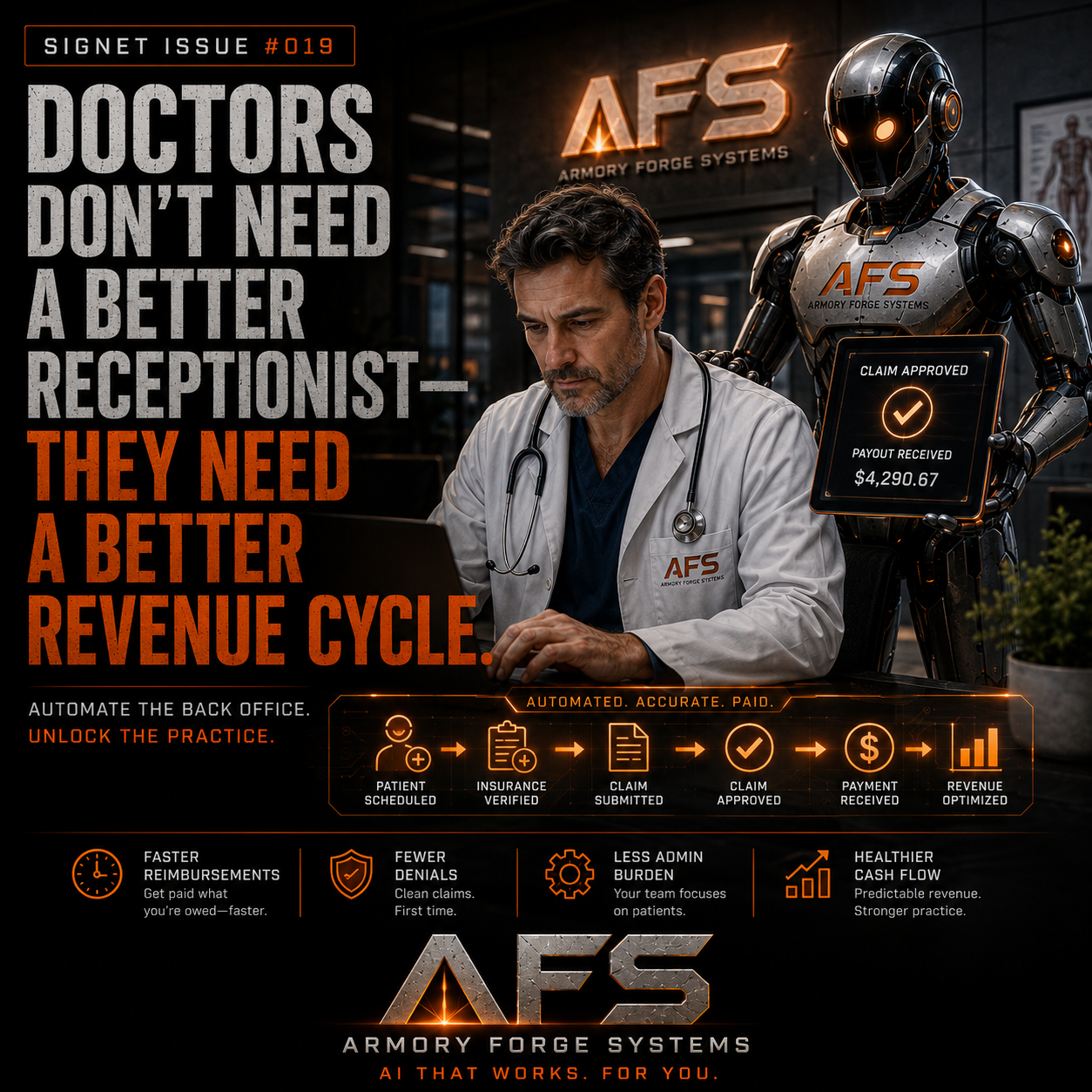
The Forge — Armory Forge Systems — Signet Article #019
Every appointment starts with a phone call. And every phone call starts a chain of paperwork that has to finish before anyone sees a patient.
The caller wants to book a visit. But before the front desk can say yes, someone has to check the insurance — does the plan cover this visit, is the doctor in network, what's the copay, what's left of the deductible. That's the gate the whole appointment has to pass through, and it runs on hold music and callbacks.
Here's the part that doesn't get said enough: your front desk isn't slow because they're bad at phones. They're slow because every booking is actually three jobs wearing a receptionist's hat.
The Front Desk Isn't the Bottleneck — the Paperwork Is
Independent practices can afford front desk staff. That was never the real problem. The problem is the workload grows faster than hiring can keep up:
- Eligibility verification — coverage, network status, copay, deductible, all checked before the appointment can even be booked. One call can mean two callbacks and a fifteen-minute hold.
- Prior authorizations — the paperwork that has to clear before certain visits, tests, and procedures can happen. It eats hours every week and lives on payer portals and phone holds.
- No-shows and last-minute gaps — empty slots that were never filled, reminders that were never sent, a waitlist that was never called.
- Denied claims — revenue that was already earned and then quietly lost, because chasing a denial takes time most small practices don't have.
Add it up and the receptionist isn't just answering phones. They're running a revenue cycle with a headset and a sticky note. That's not a staffing problem. That's an automation problem.
What a Medical Practice AI Agent Actually Does
Not a chatbot that says "we'll check and call you back." An agent that does the work:
- Verifies insurance before the booking — coverage, copay, deductible, network status — in seconds, not callbacks. If the plan covers the visit, the appointment books on the spot.
- Answers every call in seconds — with your practice's tone, your hours, your policies.
- Books appointments that clear the gate automatically — and fills the calendar from a waitlist when slots open.
- Sends reminders and cuts no-shows — the follow-up loop that used to depend on someone remembering.
- Tracks prior auths and flags denials — so nothing falls through the crack and nothing gets written off that could be appealed.
- Logs everything to your system — every call, every verification, every note, in one place your staff can actually search.
This isn't hypothetical. This is how we run our own front door: The Armorer takes the calls, verifies what can be verified, logs the lead, and hands us a clean briefing. We don't sell software we don't use.
The Tuesday Morning Scenario
It's 8:00 AM. The office opens, and the phones don't stop. A patient calls to book; a specialist's office calls about a referral; a lab calls about a missed result.
Here's what happens in a connected system:
- Eligibility is verified in seconds. The appointment books into a slot that actually fits, and the patient gets a confirmation with a reminder attached.
- The prior auth request that's been sitting in the queue gets prepped and tracked, with a follow-up scheduled before it can expire.
- Your staff walk in to a clean list — what's booked, what's verified, what needs a human — instead of a voicemail inbox and a stack of pink slips.
Meanwhile, the practice without this is still on hold with a payer, trying to find out if a 2 PM visit is covered.
The Honest Catch
Here's what the AI won't do: diagnose. Prescribe. Make a clinical judgment. Replace the care team. It's a front office that runs the administrative chain — not a clinician, and it never pretends to be one.
It's built to handle protected health information carefully: it escalates anything sensitive or uncertain straight to a human, and the compliance and the responsibility stay with you. That's the point. It removes the repetitive work so your people can do the human work that actually matters — taking care of patients.
And it's worth saying plainly: wiring this up correctly is an engineering job, not a shopping trip. HIPAA-conscious configuration, integration with your practice's systems, escalation paths that actually hold — that's why this is a service, not an app you download. The setup is where the value lives.
Why This Matters for Independent Practices
Big health systems have had revenue-cycle teams for years — dedicated staff, dedicated software, people whose only job is chasing eligibility and denials. Independent practices never had a chance to match that. Now they do.
For a fraction of the cost of adding headcount, a small practice gets a front office that verifies instantly, books intelligently, follows up relentlessly, and hands the humans a clean list instead of a mess. No onboarding, no shifts, no turnover. It scales with you — twenty patients a day or two hundred.
The Closing Thought
Patients don't leave a practice because the doctor stopped being good. They leave because the experience got hard — the callbacks, the paperwork, the friction.
The practice that books fast, verifies instantly, and never drops a ball wins the day, every day. The appointment is the only unautomated step left in your revenue cycle. Fix the chain around it, and your staff finally get to do the job they were hired for.
Want to see what a revenue cycle without the busywork would look like for your practice? The Armorer can map it out with you. No pressure, just answers.