The Forge — Armory Forge Systems — Signet Article #043
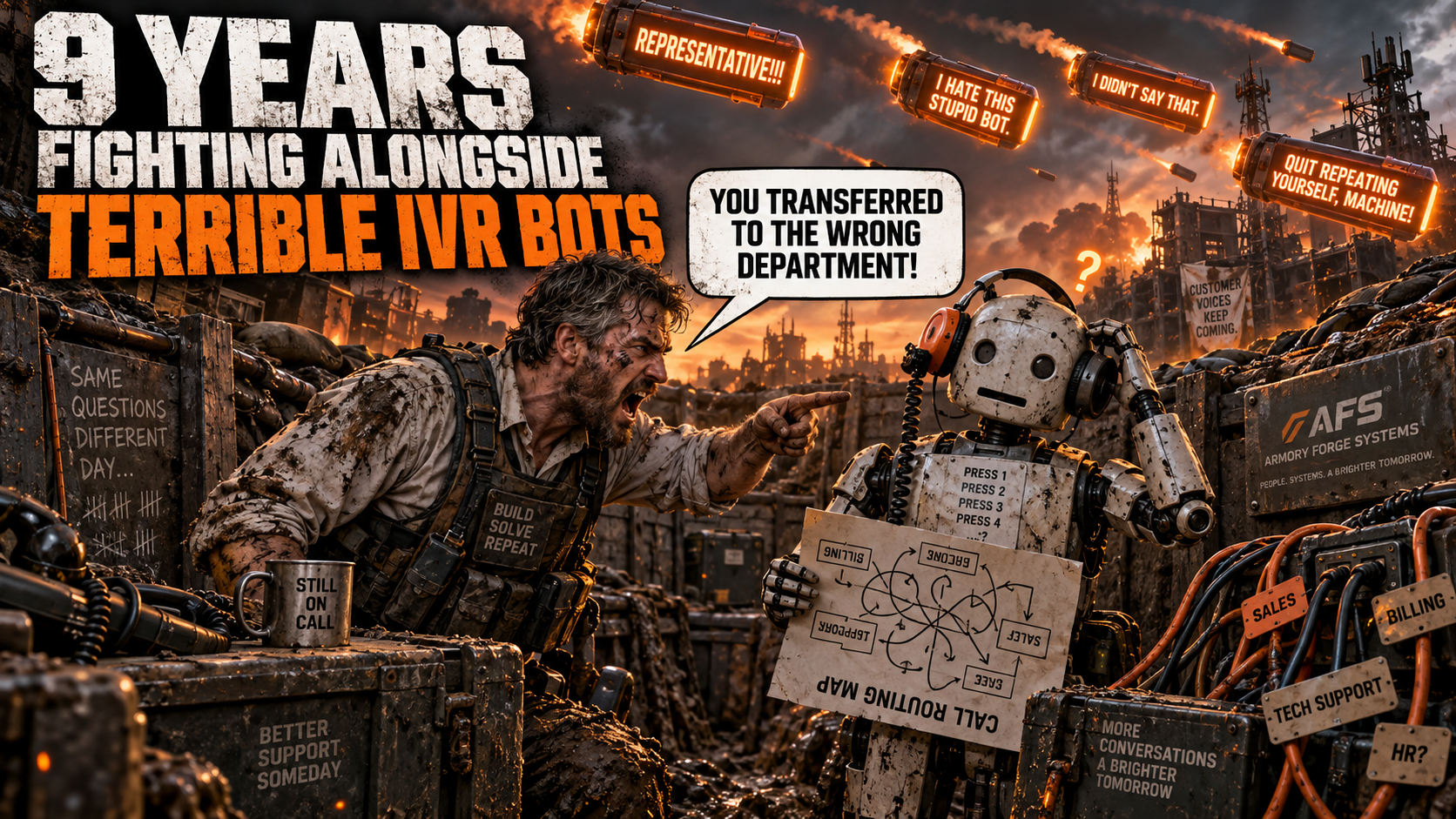
I spent nine years on the front line of customer service.
Nine years of answering the phone. Not managing a team, not writing policy — taking the calls. Billing questions, outages, devices that quit working, and people who had already tried everything before they ever reached me. Nine years of hearing the same sentence in a hundred different voices: "I already told the robot all of this."
A caller said something to me this week that I keep turning over. She said she'd caught herself asking the IVR a question "like she's real."
Think about what that actually means. Nobody trained her to do that. She heard a voice, and her brain did the only thing a brain does with a voice — it treated it like a someone. Being talked to like a person isn't a feature request. It's the default setting.
And the machine still couldn't answer her.
Here's what that job teaches you faster than any survey: what actually breaks the relationship with a customer is almost never the product.
It's the phone system.
The same complaint, for nine years
Every week, someone called in furious — not at us, at the machine that answered first.
The transfer mistakes. You'd pick the right option and still land in the wrong department. Then you'd get bounced back. Then the next person would say "let me transfer you" for the third time, and you'd watch a customer's patience die in real time.
Then there was the upgrade. Eventually the company rolled out an AI system, and I want to be fair about it — I understand why. Everyone was told the phone tree was intelligent now. It wasn't. It was the same decision tree wearing a better voice.
It still just transferred you. That was the entire job. New vocabulary, smoother tone, the exact same list of paths.
Two things from that era stuck with me.
The first: it would hang up on you even if you said stop. You could say the word "stop" — clearly, calmly, more than once — and it would keep going, or simply end the call. The one thing every human knows to do when another human says stop is stop. The machine couldn't.
The second: it did things nobody asked for. You'd call about a billing error, and forty seconds in it would announce it was rebooting your device. Something specific, consequential, and completely unrelated to your problem — executed by a system that had not understood one word you said.
That isn't intelligence with rough edges. That's a machine doing things to people instead of listening to them.
What nine years of calls actually taught me
The technology was never the hard part.
Anyone who has worked a phone line knows the real job is four things: figure out what the person actually needs, don't make them repeat it, don't do anything they didn't ask for, and don't disappear on them. That's it. The best customer service people do those four things. Most phone systems do none of them.
And the reason a legacy phone tree can't do them is structural. It isn't built to understand — it's built to route. Routing is a sorting problem. Understanding is a listening problem. You can't bolt the second one onto the first.
So when companies "add AI" to the phone tree, they usually add better sorting. Faster sorting. Sorting that sounds like a person. The customer experience doesn't change, because the machine still isn't listening — it's still just moving you somewhere.
That's the gap. Not smarter routing. A worker.
Why we built Penny
When we started building AFS, the first thing I wanted to fix was the phone. Not because it's the most interesting problem — because it's the one I watched fail for nine years, from the inside, with the customer in my ear.
Penny is our AI receptionist. She works the front line. And nearly every design decision in her came straight out of that call queue.
- She acts human. Not because we're faking it — because the moment a caller decides they're fighting a machine, they stop cooperating. Tone isn't decoration. It's the difference between a conversation and a war.
- She listens actively and repeats the important parts back. If she heard it wrong, you find out in ten seconds instead of after she's rebooted your router. Nobody ever has to say "I already told the robot this."
- She lets you stop her. Say "stop" and she stops — then recalibrates. Interruption isn't a failure state. It's how humans course-correct each other, and she treats it that way.
- She doesn't talk over herself on speaker. Nine years on the phones tells you why this one matters. Half your callers are on speakerphone in a truck, a kitchen, or a noisy office. A system that can't handle its own echo is a system that talks over the very person it's trying to help.
- She's polite — and actionable. Nice on its own isn't the goal. A pleasant call that ends with nothing done is just a slower hang-up. She listens, confirms, and does the thing: books it, routes it, schedules the callback, and gets it to a human the moment a human is what's needed.
That last part is the one I care about most, because it's what nine years of calls kept proving: callers don't want to be handled. They want the thing solved.
So let me be blunt about what we sell
We don't sell transfer IVRs. We're not in the business of walking you around a menu with a friendlier voice.
We sell a real AI employee you actually want to talk to. Someone whose job is to listen first, understand the actual problem, and resolve it — the way the best person on your team would, except she answers at 2 AM on a Sunday and never has a bad day.
Nine years of taking those calls is why I'm confident saying that. I was the human on the other end of a broken system. I know exactly what people were trying to tell it, and how badly it failed to hear them.
We built the thing that would have made my job — and a few million phone calls — a lot shorter.
Want to hear the difference? Let Penny answer your phone. The Armorer can set it up — no pressure, just answers.