The Forge — Armory Forge Systems — Signet Article #039
Somewhere right now, a competitor is doing something that will hurt your business — and you won't find out about it until it already has.
Maybe they dropped their prices last Tuesday. Maybe they signed the supplier you depend on. Maybe a regulation changed that makes your whole service model harder, or a trend started that makes it obsolete. Big companies don't miss those moments. They have research departments — people whose entire job is watching the market, reading the noise, and knowing what changed before it matters.
Most small businesses have nobody doing that. Not because they don't care. Because a research department costs six figures a year, and you're already wearing five hats.
That's the gap Scout closes.
Research isn't a tool. It's a worker.
You can search for things. Everyone can search for things. That's not what a research department does.
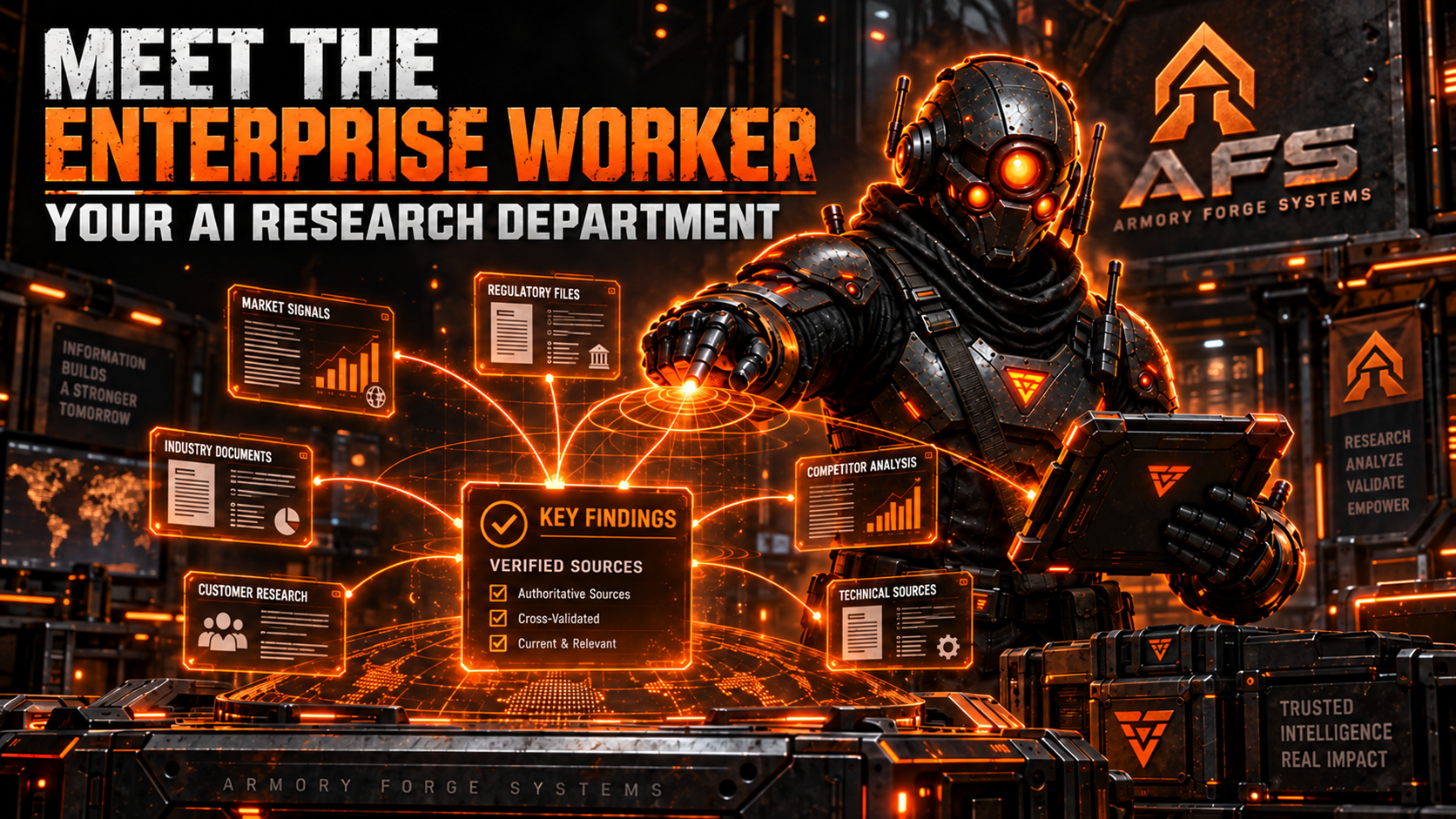
A research department doesn't wait for you to ask. It watches — continuously, across your market, your competitors, your industry — and it brings you what matters before you knew you needed it. It answers the messy questions, the ones that don't have a single right page: "Is our pricing still competitive?" "Who's winning in our area and why?" "What's changing in our industry that we should care about?" And when it hands you an answer, it shows its work — so you know it's a fact, not a guess.
That's Scout. Not a search box you visit when you remember. A worker who's always on the job, doing the reading you don't have time to do.
The questions every business is guessing at
Walk through an ordinary week and count how many decisions get made on vibes:
- Should we hold our prices or move? — depends on what the market is doing.
- Is that new competitor actually taking our customers? — depends on what they're offering, and to whom.
- Are we early or late on this trend? — depends on what's actually happening, not what's being hyped.
- Did anything change with our suppliers, our regulations, our customers' expectations? — depends on a hundred small signals nobody has time to track.
Individually, each one seems fine to wing. Collectively, they're the difference between a business that steers and a business that reacts. Scout turns "we think" into "we know" — on every one of those questions, all week, every week.
What it feels like to have a research department
Imagine a worker who knows your industry the way you wish everyone did.
In the morning, there's a briefing waiting: what changed in your market overnight, what your competitors did this week, what's worth your attention — and what's just noise. When you're weighing a decision, you ask the question in plain language and get a straight answer with the receipts, so you can trust it or dig deeper. When something important shifts, you hear about it because it's relevant to you — not because you happened to scroll past it.
You don't get a wall of links. You get a colleague who did the reading and tells you what it means, then points at exactly where it says so.
The expensive part isn't the research. It's the late research.
Here's the thing about market intelligence: it compounds. Knowing about a competitor's price change the week it happens is a small advantage. Knowing about the trend two years before everyone else — because you watched it form — is the entire game. The difference between companies that ride a shift and companies that get run over by it is rarely talent or capital. It's usually just that one of them saw it coming.
That's why research is the department small businesses skip and giants never do. The giants aren't smarter. They just have someone whose job is watching. Scout gives you that someone — without the payroll, the office, or the six-figure budget.
Your call, your business
Scout doesn't make decisions for you. A research department never did. It brings you the facts, the context, and the early warning — and the judgment stays exactly where it belongs: with you.
The market is moving whether you watch it or not. The only question is whether you find out from the briefing — or from the customer who left.
Armory Forge Systems builds AI workers that run real departments for small businesses. Scout is your research department. Ask him what your competitors did today.