The Forge — Armory Forge Systems — Signet Article #059
Tomorrow, November 3, Americans vote in a midterm election that will be covered mostly as a referendum on everything except the thing I'm going to write about.
So let's be specific instead of loud. There are decisions sitting in front of the federal government right now that will determine what it costs you to use artificial intelligence in your business for the next decade — whether you can buy a model from a vendor in another state, whether you need a lawyer to read your AI contract, whether the rules you follow were written in Washington or in your state capital. Those decisions are waiting on a Senate that hasn't made them.
Here is what is actually on the table, what the Senate can and cannot do about it, and what both parties have said they want. Then you can decide what you think, and vote accordingly.
First, the math — because the math is the whole story.
The Senate has 100 seats. Republicans currently hold 53, the Democratic caucus 47, which includes two independents who caucus with them. Thirty-three seats are up for regular election tomorrow, plus special elections in Florida and Ohio — 35 contests total, and 22 of them are Republican-held seats. That's the entire reason this cycle is interesting: the map is stacked in one party's favor, which means small shifts in a handful of states move the gavel. Cook Political Report rates 11 Senate races as competitive, seven of them toss-ups.
To take control, Democrats need a net gain of four seats. Anything less leaves the chamber where it is. That is the number to hold in your head while you read the rest of this.
Why this one lasts longer than the news cycle.
Federal elections get discussed in two-year increments. The seats decided tomorrow are not two-year seats. The winners take office on January 3, 2027, and their terms run until January 3, 2033.
That is the actual horizon of this vote. Not the next news cycle. Not the next budget fight. 2033.
Now put that horizon next to the technology curve. The people building frontier systems — and most of the people trying to regulate them — expect the steepest part of that curve to land inside this exact window: agents that operate unsupervised for hours instead of minutes, models that design and run their own experiments, systems embedded in power grids, logistics, hospitals and defense. Going vertical is the shorthand for it.
Every previous round of technology rules was written against a version of the technology that looked tame by the time the rule took effect. This is the first Congress whose AI decisions will be judged against the version of the technology that arrives during its own term.
So the sequence matters more than any single bill. The committee chairs seated in 2027 decide which proposals get hearings in 2027 and 2028. The agency heads confirmed in 2027 write rules that take effect around 2029. The framework passed, or not passed, in 2028 sets the defaults that the 2031 deployments operate inside. A two-year delay in getting the rules right is not a two-year delay — it is a decision to let the steepest stretch of the curve run on whatever defaults happened to exist.
This is not a hundred-year election in the sense that one vote settles a century. No vote does that. It is a hundred-year election in the sense that the compounding starts here. The shape of the rules, the competence of the agencies, and whether the two parties remain capable of negotiating with each other all get set while the curve is still climbing. Institutions built during a steep curve outlast the curve. That is the part of this election nobody will be talking about on the night of November 3rd, and it is the part that will still matter in 2032, in 2042, and beyond.
Why the Senate, and not just the Senate.
The Senate is not the only author of AI policy, and anyone who tells you otherwise is selling something. The House writes its own bills. The White House writes executive orders. Agencies write rules. Courts strike things down. And 40-plus state legislatures have already written more than a hundred AI laws of their own — 109 AI laws and 28 data center laws in the first half of 2026 alone, on top of 159 AI laws enacted in 2025.
But the Senate is the narrowest gate in the federal process, for four structural reasons:
One: sixty votes. Most legislation needs 60 votes to proceed, which means the majority party cannot pass AI law alone. A 51-seat majority sets the agenda; it does not guarantee an outcome. Any federal AI framework that survives will be a negotiated object, not a party platform.
Two: committee gavels. Whoever holds the majority chairs the committees, and the committees decide what gets a hearing, what gets a markup, and what quietly dies. On AI, that means Senate Commerce above all — plus Judiciary for antitrust and copyright, Homeland Security for cyber, Armed Services for the defense-tech lane, and Banking for the financial-side questions. A chair can spend two years not scheduling a vote. That is a policy decision.
Three: confirmations. Agency leadership — the people who write the actual rules under the statutes — gets confirmed by the Senate. A chamber that wants a hands-off FTC confirms a hands-off FTC. A chamber that wants an enforcement-forward one confirms that instead.
Four: appropriations and the must-pass bills. Preemption language rarely travels on its own. In this Congress it has been attached to, or attempted on, the National Defense Authorization Act and the reconciliation package — the 2025 attempt to impose a moratorium on state AI laws through reconciliation was rejected by the Senate. Whatever gets attached to the next must-pass vehicle is decided by whoever controls the floor.
What both sides have actually said. In their own framing.
I'm not going to tell you which of these is correct. I'm going to tell you what's on the record.
The administration's position, as written: in December 2025 the President signed an executive order directing a national policy framework for AI and creating a Department of Justice task force to challenge state AI laws judged not "minimally burdensome." It also directed the FTC to issue a policy statement on state laws that require changes to AI model outputs, and directed Commerce to examine conditioning broadband (BEAD) funding on states' AI legislation. In March 2026 the White House followed with a National Policy Framework for Artificial Intelligence — legislative recommendations asking Congress to pass a federal framework that preempts conflicting state AI laws, while signaling that child-safety laws and data center or compute regulation were less likely targets. The argument is that a 50-state patchwork is unworkable for anyone building a product, and that fragmentation costs the country its lead.
The Democratic position, as currently being sketched: Senator Maria Cantwell, who would take the Senate Commerce Committee gavel if her party wins the majority, has outlined a set of safety principles she says should underpin AI legislation — reported in October as a marker laid down ahead of the election rather than a bill. The broad shape is federal guardrails on the highest-risk uses, with an enforcement structure behind them, rather than preemption-first. The counter-argument from that side is that preemption without a federal standard replaces fifty rulebooks with none.
Note what both have in common, because it's the part nobody campaigns on: both are arguing about who writes the rules, and both accept that rules are coming. Neither party is proposing that AI go ungoverned.
And preemption is not unanimous inside the Republican caucus either. Attempts to insert AI preemption language into the defense authorization bill have reportedly stalled — which tells you the fight is not purely partisan. It's also jurisdictional, and it's also about which industries get protected.
What this means if you run a business.
Here's the part I actually care about, and the reason this belongs on a page about building companies rather than on a politics site.
You are going to feel AI policy first as paperwork. Not as a grand national strategy — as a vendor contract, a disclosure requirement, a data-residency clause, an audit request, a checkbox in a procurement portal. Whether that paperwork is one federal standard or fifty state ones is the live question, and it changes your cost of compliance more than any single rule's content.
So regardless of what happens tomorrow, the following is true on Wednesday morning:
Know what AI you're running. Most small businesses now use AI in at least four places without a single list of them — the phone system, the inbox, the marketing tool, the bookkeeping software. You cannot comply with, or benefit from, a policy you can't inventory.
Read the data terms, not the feature list. Where does your data go, is it used for training, can you get it deleted, who is the subprocessor, what happens on termination. This is where policy becomes real money.
Keep a human on the decisions that matter. Approval gates on money movement, customer communications, hiring, and anything that touches a regulated record. Every serious regulatory proposal on the table — from either direction — assumes human accountability somewhere in the loop. Build as if it will be required, because the direction of travel is one-way.
Don't build your architecture around a rule that might change. Whatever gets decided, the enforcement details will land later and move again. Systems that can be pointed at a new compliance regime without a rebuild are worth more than systems tuned to today's.
Now the part I'm not going to be cute about.
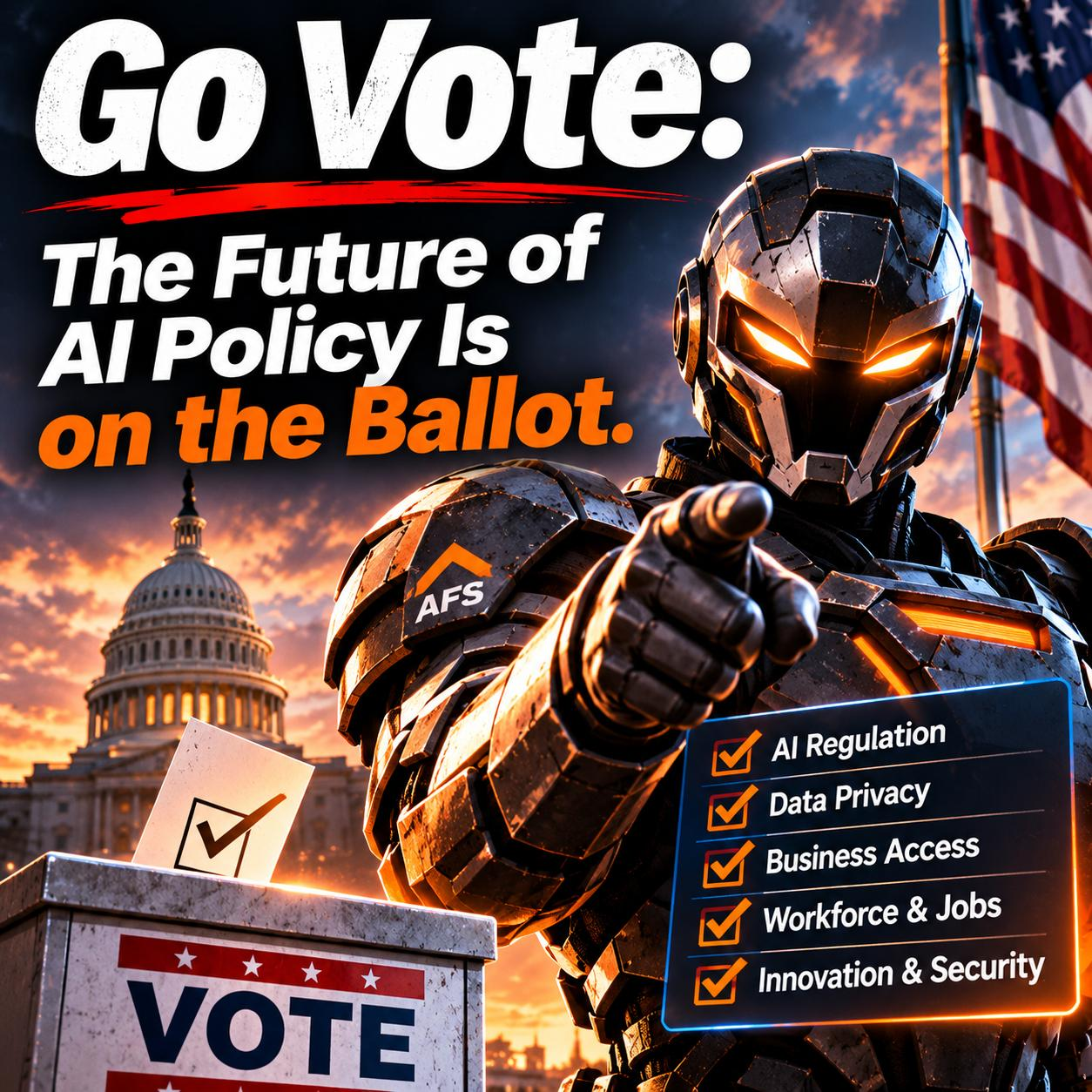
Go vote. Not because I'm going to tell you how — Armory Forge Systems doesn't endorse candidates or parties, and I'm not going to pretend a business blog has wisdom about your district.
Go vote because the specific, unglamorous decisions described above — sixty votes, committee gavels, confirmations, the preemption fight, the state patchwork — are made by people who are chosen in elections with turnout so low that the people who did show up decided it for everybody else. The AI rules that will govern your business for a decade are being written in rooms whose occupants are determined tomorrow.
If you have a mail ballot sitting on your counter, do not put it in the mail now — use an official drop box or vote in person, and check your state election office for the rules that apply to you. If you're voting in person, confirm your polling place before you go; they move more often than people expect, and a surprising number of provisional ballots are cast by people who went to last year's location. Bring ID if your state requires it.
Polls and rules vary by state. Your secretary of state's website is the authoritative source, not a social post and not a chatbot. Including this one.
Tomorrow the country picks the people who will write the rules for the steepest decade this technology will ever have — and, in the Senate's case, picks them for a term that does not end until 2033. Whatever you think should happen next, the only version of that opinion that counts is the one you act on.
You imagine. We build. To the victor, the spoils.
---
The Forge — Armory Forge Systems — Signet Article #059
Armory Forge Systems decides which work your business should hand to a machine — and then builds the workforce that owns it. We do not endorse candidates or parties.